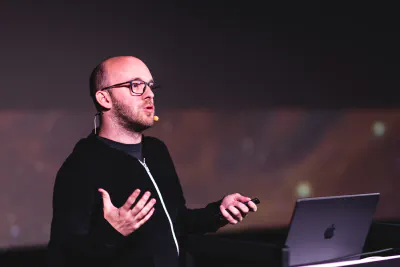
Hey! I'm Chris Reddington, a Developer Relations professional who loves bridging the gap between product teams and developers. I write, speak, and build to help developers succeed.
Featured Content
Hand-picked articles, talks, and videos that I'm most proud of.
Flight School
 GitHub
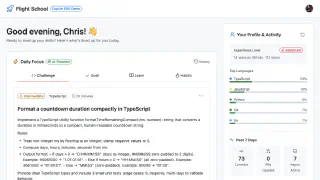
AI-powered coding practice platform built with the GitHub Copilot SDK. Personalized challenges, real-time evaluation, and learning guidance based on your GitHub profile.

Context windows, Plan agent, and TDD: What I learned building a countdown app with GitHub Copilot
Learn how I managed context to keep Copilot focused, used the Plan agent to sharpen vague requirements, and required Test Driven Development practices to catch bugs before users.

Building smarter interactions with MCP elicitation: From clunky tool calls to seamless user experiences
Explore how MCP elicitation transforms AI tool interactions by gathering missing information upfront.
Latest Content
What is EmployeeWorks? | Build EmployeeWorks plugins with ToolSmith (Part 1)
 ServiceNow
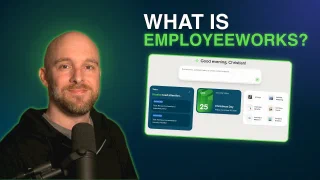
An AI assistant is only as useful as the tools you give it. The first video in the Build EmployeeWorks plugins with ToolSmith series covers the groundwork: the problem employees face moving between systems to get something done, and how EmployeeWorks gives them one place to search company knowledge and take action across the systems they already use.
Build EmployeeWorks plugins with ToolSmith
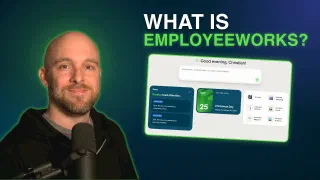
Employees shouldn't need to know which system handles their request, jump between portals, or learn how every application works to get something done. This series introduces EmployeeWorks and shows how to plan, build, review, and test well-governed plugins with ToolSmith.

Haus Carpentry & Construction
A static Astro website for a South Wales carpentry and construction business, built with no CMS, database, or client-side framework, and deployed to GitHub Pages on a custom domain.
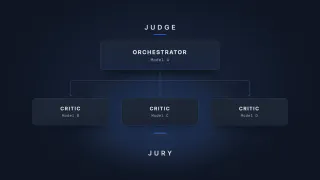
The Jury Pattern: a mixture of critics for AI code review
One model reviewing its own plan tends to agree with itself. So I built a cleanup workflow shaped like a jury: separate critics from a deliberate mix of model families weigh the evidence, with a simple forcing function that keeps neighbouring reviewers off the same family. The orchestrator presides as judge, refuting rather than merging, votes promote shared findings, and a post-approval diff check can overrule a verdict that was unanimous and still wrong.
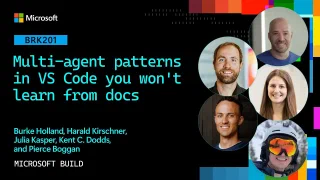
Multi-agent patterns in VS Code you won't learn from docs
GitHubBuilding with one agent is familiar. Orchestrating a fleet of them in parallel across local, background, and cloud surfaces is where it gets real. This session covers the decisions that matter, how to decompose work across agents, when to fork vs. delegate, and how to verify quality when agents outnumber you — with patterns for multi-agent workflows you can apply to your own codebase.
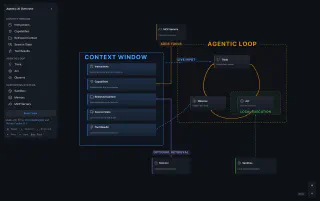
An interactive agentic AI mental model
An interactive mental model for agentic AI that explains how instructions, retrieved context, session state, memory, MCP servers, sandbox execution, tool results, and the Think-Act-Observe loop fit together.
Build EmployeeWorks plugins with ToolSmith
Employees shouldn't need to know which system handles their request, jump between portals, or learn how every application works to get something done. This series introduces EmployeeWorks and shows how to plan, build, review, and test well-governed plugins with ToolSmith.
The Jury Pattern: a mixture of critics for AI code review
One model reviewing its own plan tends to agree with itself. So I built a cleanup workflow shaped like a jury: separate critics from a deliberate mix of model families weigh the evidence, with a simple forcing function that keeps neighbouring reviewers off the same family. The orchestrator presides as judge, refuting rather than merging, votes promote shared findings, and a post-approval diff check can overrule a verdict that was unanimous and still wrong.
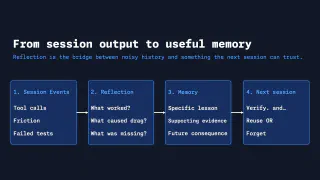
Agentic memory: what agents should and shouldn't remember
Conversation state and retrieved context lead naturally into memory, but only if we're clear about what memory is for. Rules, skills, and instruction files package what you already know. Memory should capture what the work itself teaches the system, and that means reflection, verification, and forgetting matter just as much as recall.
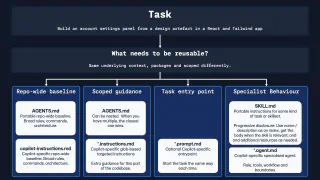
AGENTS.md and SKILL.md examples: build a reusable agent toolbox
Start with minimal AGENTS.md and SKILL.md examples, then adapt the portable core alongside Copilot-specific concepts like custom instructions, agents and prompt files. This post explains what belongs where and how to check that the files improve a real agent task.
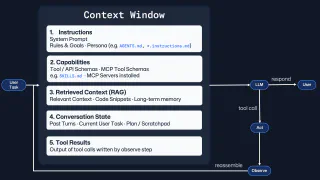
Context engineering: more context isn't better context
Better prompts help, but they're only part of the story. Context engineering is the craft of designing what an AI agent sees, when it sees it, and how that changes across the session. The goal isn't a bigger context window. It's a more effective one.
The DevRel randomisation trap (and how to stop it)
There's a pattern I've seen play out across dozens of DevRel conversations, confirmed in my MBA dissertation research: teams without a clear golden thread from company strategy to daily activity get 'randomised' by whoever asks most urgently. Here's what the research says about why it happens and how to build your way out of it.
Multi-agent patterns in VS Code you won't learn from docs
GitHubBuilding with one agent is familiar. Orchestrating a fleet of them in parallel across local, background, and cloud surfaces is where it gets real. This session covers the decisions that matter, how to decompose work across agents, when to fork vs. delegate, and how to verify quality when agents outnumber you — with patterns for multi-agent workflows you can apply to your own codebase.
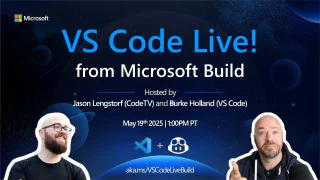
VS Code, Live — Straight from Microsoft Build! 🪐
GitHubJoin VS Code, Live! at Microsoft Build. For the first time ever, VS Code, Live! is going on stage—in person—and you’re invited! Get an inside look at what the team’s building, featuring live conversations with devs and creators. Whether you’re deep into VS Code or just curious about what’s next, this is your dev-first, code-forward pass to what’s new.
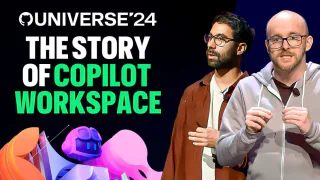
How GitHub Next took Copilot Workspace from concept to code
GitHubWhether you’re addressing an issue, iterating on a pull request, or bootstrapping a project, GitHub Copilot Workspace helps jumpstart your tasks by describing what you want in natural language. You remain in control as you move between tasks, specs, plans, and code. Join GitHub's Chris Reddington, senior program manager of DevRel, and Cole Bemis, research engineer on GitHub Next, for an introduction to Copilot Workspace, a Copilot-native dev environment launched in April 2024 by GitHub Next. Learn how Copilot Workspace works, how we got here, and what we've learned so far from the technical preview.
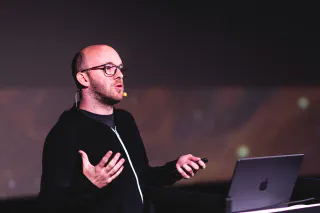
Hands on with Anthropic Claude 3.5 Sonnet in GitHub Copilot
GitHubCome to this session to be the first in the world to get a deep-dive demo of the exciting Claude 3.5 Sonnet model from Anthropic built right into GitHub Copilot. Learn what this powerful new model will help you achieve and why you should use it for your development teams.
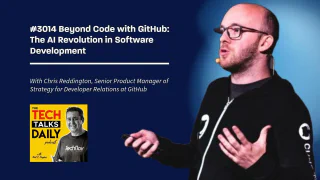
Beyond Code With Github the AI Revolution in Software Development
As AI continues to reshape the way businesses innovate, the conversation shifts beyond the mere integration of new technology. Chris emphasizes that adopting AI-powered software development is a significant cultural shift, requiring more than just technical tools. It demands a top-down approach, where leadership support and change management are critical to fostering a progressive culture within development teams.

GitHub Galaxy 2024 Amsterdam
Ready to explore our blueprint for AI-powered development? Join us to network with local tech leaders and learn the key to addressing tech debt, modernizing the software development lifecycle, and transforming your enterprise.
What is EmployeeWorks? | Build EmployeeWorks plugins with ToolSmith (Part 1)
ServiceNowAn AI assistant is only as useful as the tools you give it. The first video in the Build EmployeeWorks plugins with ToolSmith series covers the groundwork: the problem employees face moving between systems to get something done, and how EmployeeWorks gives them one place to search company knowledge and take action across the systems they already use.
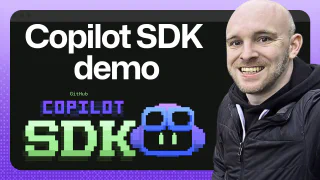
GitHub Copilot SDK demo: Creating "Flight School"
GitHubChris Reddington demonstrates "Flight School," a custom Next.js application built to personalize his learning journey using the GitHub Copilot SDK. See how he leverages agentic workflows to generate daily coding challenges based on his GitHub profile, evaluate solutions against test cases, and automatically export projects to new repositories.

Rubber Duck Thursdays - Let's build with GitHub Copilot SDK
GitHubJoin us for Rubber Duck Thursdays! A lighthearted and informal stream where we live code on some projects. This week we explore how to bring the power of GitHub Copilot into your apps with the GitHub Copilot SDK, building hands-on examples and discussing patterns for integrating AI-powered coding assistance directly into developer tools and workflows.

Rubber Duck Thursdays - It's time to build!
GitHubChris showcases Timestamp, an open-source countdown timer app built with vanilla TypeScript featuring an extensible theme system, world map wall clock, and 2500+ unit tests with 300+ Playwright end-to-end tests. He deep-dives into structuring GitHub Copilot custom instructions vs agents vs prompt files, demonstrates manager-specialist agent patterns, and walks through GitHub Actions automation for issue forms and theme scaffolding.

Rubber Duck Thursdays - Let's build our way into 2026!
GitHubChris builds a New Year countdown app from scratch using Vite, TypeScript, and Tailwind CSS, leveraging GitHub Copilot's Plan agent for iterative requirements and a custom UI Performance Specialist agent. The stream covers adding time zone support with a world map, a fireworks celebration theme using fireworks.js, and a test-driven development approach.

Rubber Duck Thursdays - Let's build down tech debt
GitHubChris reviews the latest GitHub changelog including CodeQL updates, GPT-5.1 Codex Max preview, GitHub MCP server tool-specific configuration, and Enterprise Server 3.19 GA. He then explores the major VS Code December release featuring Agent HQ, background agents with git worktrees, sub-agents, and custom agents for organizations, while continuing to build custom agents for a game MCP server project.