Content
Cloud Drops - Using Microsoft Learn to get started with Azure
Microsoft Learn is a gamified education hub on docs.microsoft.com covering Azure, GitHub, Microsoft 365, and more through modules, learning paths, and the LearnTV video platform. Browse the catalogue by role, level, or product, earn XP to level up, and use renewal assessments to recertify without retaking full exams.
V014 - Tech Roundup #14 Azure, DevOps & GitHub Blogs, Azure Updates & New CloudWithChris content
In this Easter Sunday livestream, Chris covers Microsoft's Forrester Wave leader recognition for Azure Functions (FaaS), a wave of AKS updates including the new run command feature and Open Service Mesh add-on, and the GitHub Advanced Security security overview beta plus GA of secret scanning for private repositories. Delivery Plans 2.0 in Azure DevOps approaches GA with card styling and dependency visualisation, while GitHub Desktop gains cherry-pick support and GitHub Mobile adds working-hours notification controls. Cloud with Chris highlights include a beginner Git 101 Cloud Drop, a community blogging panel, the External Configuration and Claim Check architecture pattern episode with Peter Piper, and a preview of the upcoming Northern Azure User Group talk alongside Scott Hanselman.
Cloud Drops - How Windows Terminal can make YOU productive with Azure
 Cloud with Chris
Windows Terminal is a modern multi-shell application available via the Microsoft Store or winget, supporting Windows Command Prompt, PowerShell, PowerShell Core, WSL distributions, and Azure Cloud Shell in a single window. This Cloud Drop demonstrates installing Windows Terminal, connecting to Azure Cloud Shell via device code login, and creating custom SSH profiles to connect directly to Azure virtual machines from both Windows OpenSSH and WSL.

33 - External Config and Claim Check Pattern - Easier Management and Externalising Payloads
Chris and Peter cover two cloud design patterns in depth. The External Configuration Store pattern addresses one of the most critical security concerns in cloud development: keeping secrets and connection strings out of source code. They explore Azure Key Vault and Azure App Configuration as canonical implementations, discuss deployment slot behaviour, and highlight the risks of committing credentials to version control. The Claim Check pattern tackles a different challenge — what happens when your message payload exceeds the size limits of your messaging infrastructure (Azure Service Bus, Azure Queue Storage)? By externalising the payload to a data store and passing only a correlation ID on the queue, you gain scalability and flexibility at the cost of added latency. Azure Event Grid's automatic claim check generation is also demonstrated. Security is a thread running through both patterns: compromised config stores and poisoned messages both demand an operational response plan.
Why use Git, How it Works and what's going on behind the scenes?
I've recently released a few Cloud Drops episodes on Git related content. The Git Behind the Scenes video was incredibly well received. I'm also aware from my day-to-day discussions that there's a mix of experiences with Git, so also made a Git 101 Video. In this Cloud World that we live in, version control is an important concept beyond the 'traditional' developers. Infrastructure Engineers can now version control their Infrastructure as Code, or maintenance scripts. Data Scientists can version control their experiments and tests. And of course, developers can version control the code for their software. I also consider version control as a gateway or first step into the world of DevOps. Typically when you think about build and release pipelines, you are triggering based upon some version control event (e.g. a commit to a particular branch, a merge of a pull request, etc.). Over the past few years, I've seen a trend where organisations are looking to automate quickly, rather than relying on the traditional hands-on-keyboard approach which can be error-prone and time consuming. Whether we're talking in this context about Infrastructure as Code, Application Code, database schemas as code, data science experiments or any other representation as code, it doesn't matter. Typically the roads lead back to the same place, to version control. So in this blog post, I'll be covering the fundamentals of Git and how to get started. For anyone that is particularly inclined, there will also be some information on what's happening behind the scenes when you work through these fundamental concepts.

How to get started blogging and choosing your platform - Panel Discussion
Chatting to some colleagues about blogging and sharing our success stories and failures!
Cloud Drops - Git 101 - Why use Git, and how to get started
Git is a distributed version control system where every developer holds a complete copy of the repository and its history locally, enabling offline work and fast branching. This Cloud Drop covers git init, git add, git commit, git status, git log, git push, git pull, and git clone, plus VS Code's built-in Git integration and the Git Credential Manager for authenticating against GitHub and other remote hosts.
V013 - Weekly Technology Vlog #13 (Lots of Azure, DevOps & GitHub) Blogs, Quick-fire Azure Updates
Weekly Vlog #13 covers an action-packed Azure week: enterprise landing zones with modular designs, zonal disaster recovery via Azure Site Recovery, Security Center compliance enhancements, and Mark Russinovich's standout Ignite session on Azure innovation. The GitHub roundup highlights the GitHub Actions capture-the-flag security writeup and a multi-stage exploit chain from the GitHub Security Lab — essential reading for any DevSecOps practitioner. Cloud with Chris updates include the channel's most-viewed video to date on Git internals, a Fuse.js-powered site search, series navigation, and a packed April talk schedule featuring the Northern Azure User Group (alongside Scott Hanselman) and Global Azure Bootcamp.
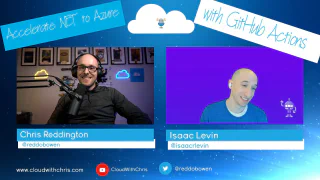
32 - Accelerate .NET to Azure with GitHub Actions
Cloud with ChrisGitHub Actions makes it easy to automate your entire .NET software delivery pipeline — from build and test through to deployment on Azure. In this episode, Chris Reddington is joined by Isaac Levin, Senior Product Marketing Manager at Microsoft and a lifelong .NET developer, to walk through how GitHub Actions YAML workflows streamline deploying .NET and ASP.NET Core applications to Azure App Service, Azure Functions, and Azure Static Web Apps (including Blazor WebAssembly). Isaac traces the evolution of CI/CD tooling from FTP and CruiseControl.NET through to modern GitHub Actions, demonstrates how Azure and Visual Studio integrate to auto-generate workflows, and shares practical tips for getting started quickly.

DevOps in a Cloud World
Chris joins Mert Yeter on the MSHowTo show talking all things DevOps, including CI/CD tools, Azure DevOps and GitHub, Azure Development related tooling, and the importance of monitoring as part of a DevOps approach!