APIs

CGN4 - Cloud Gaming Notes Episode 4 - Cross-platform social Sudoku with Azure PlayFab
Chris is joined by Dominic, a Senior PM Manager in Microsoft Teams Engineering, who spent nearly two years building Sudoku Social as a passion project — the world's first cross-platform competitive Sudoku game for iOS and Android. Dominic walks through his decision to use Unity for its build-once deploy-to-many capability, and Azure PlayFab as the game backend-as-a-service powering leaderboards, friend systems, matchmaking, and player statistics. The conversation covers how PlayFab's APIs dramatically reduced backend development effort, how Azure DevOps supported the CI/CD pipeline for the game, and the iterative learning journey of a first-time game developer teaching himself Unity, iOS, and Android development simultaneously.
CGN3 - Cloud Gaming Notes Episode 3 - Inventory and Economy
Gaming has evolved from isolated save files to persistent, cloud-powered experiences that follow players across every device they own. In this third episode of Cloud Gaming Notes, Chris and Lee Williams explore the cloud architecture behind in-game inventory and economy systems — using Sea of Thieves as a live example. Topics include persistent state management with Azure Cosmos DB, managed gaming backends with PlayFab, Live Ops patterns, and how cloud infrastructure enables monetisation and long-term player retention at scale.
33 - External Config and Claim Check Pattern - Easier Management and Externalising Payloads
Chris and Peter cover two cloud design patterns in depth. The External Configuration Store pattern addresses one of the most critical security concerns in cloud development: keeping secrets and connection strings out of source code. They explore Azure Key Vault and Azure App Configuration as canonical implementations, discuss deployment slot behaviour, and highlight the risks of committing credentials to version control. The Claim Check pattern tackles a different challenge — what happens when your message payload exceeds the size limits of your messaging infrastructure (Azure Service Bus, Azure Queue Storage)? By externalising the payload to a data store and passing only a correlation ID on the queue, you gain scalability and flexibility at the cost of added latency. Azure Event Grid's automatic claim check generation is also demonstrated. Security is a thread running through both patterns: compromised config stores and poisoned messages both demand an operational response plan.

29 - The Sidecar and Ambassador Patterns
When modernising a legacy application, rewriting everything from scratch is rarely feasible. The Sidecar and Ambassador cloud design patterns offer a pragmatic alternative — attach a companion process to offload cross-cutting concerns like retry logic, circuit breaking, and protocol translation without modifying the application itself. Chris and Peter explore both patterns in depth, covering when to use each, how they relate to service meshes, and their role in Kubernetes-based architectures.
23 - Gatekeeper and Valet Key Patterns - Secure your APIs and Resources
Continuing the 'Architecting for the Cloud, one pattern at a time' series, Chris and Peter Piper explore two closely related cloud design patterns for securing APIs and backend resources. The Gatekeeper pattern positions a dedicated host between untrusted clients and trusted backend services — handling authentication, authorization, request validation, protocol translation, and rate limiting. The Valet Key pattern complements it by issuing short-lived, scope-restricted tokens (such as Azure SAS tokens) so clients can access specific resources directly, reducing load on central services without sacrificing security. The episode covers practical implementation options on Azure including API Management, Azure Key Vault, and Azure App Configuration.
20 - The Anti-corruption layer, Gateway Aggregation and Gateway Routing patterns
 Cloud with Chris
Peter Piper joins Chris Reddington for another episode in the Architecting for the Cloud, One Pattern at a Time series. Building on the Façade and Strangler patterns, they explore three related cloud design patterns: the Anti-Corruption Layer (translating between legacy and modern domain models), Gateway Aggregation (collapsing multiple backend calls into a single client response), and Gateway Routing (layer-7 routing to decouple consumers from versioned backend services). Real Azure service examples — including API Management, Application Gateway, and Azure Front Door — are used throughout.
19 - The Event Sourcing, Materialized View and CQRS Patterns
What if you stored not just the current state of your data, but every event that produced it? The Event Sourcing pattern captures the full history of changes as an append-only log — enabling audit trails, temporal queries, and history replay. Combined with Materialized Views for efficient read-side querying and CQRS for command/query separation, these three patterns form a cornerstone of modern event-driven architecture. Chris and Steph explore all three in this episode of Architecting for the Cloud.
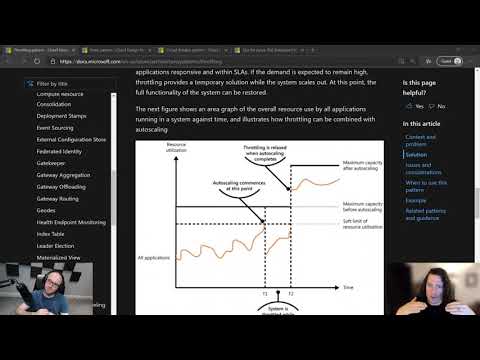
17 - The Throttling, Retry and Circuit Breaker Patterns
How do you protect your infrastructure from traffic spikes, safeguard multi-tenant workloads from noisy neighbours, and handle transient failures gracefully? Chris and John Downs walk through three essential cloud resilience patterns: Throttling (protecting services from excess load via rate limiting and HTTP 429), Retry (handling transient faults with exponential backoff), and Circuit Breaker (preventing cascade failures). Part of the "Architecting for the Cloud, One Pattern at a Time" series — essential viewing for any developer building on Azure.
16 - The Backends for Frontends and Strangler Pattern with Peter Piper
Managing APIs across web, mobile, and multiple consumer types creates tight coupling that slows modernisation and makes versioning painful. In this episode, Chris Reddington is joined by Peter Piper to explore the Backend for Frontends (BFF) pattern — creating dedicated backends tailored to each consumer — alongside the Strangler Fig pattern for incrementally migrating legacy monoliths without disrupting existing clients. The Façade pattern also features as a key decoupling mechanism for smooth API migrations. Part of the "Architecting for the Cloud, One Pattern at a Time" series.

12 - Modern Identity Patterns
Chris is joined by Christos Matskas — former Microsoft Premier Field Engineer, developer tools evangelist, and .NET identity expert — for a deep-dive into modern identity patterns in the cloud. They cut through the confusion between Azure AD, Azure AD B2B, Azure AD B2C, and External Identities, explain why the network perimeter is no longer your security boundary, and make the case for letting battle-hardened libraries like MSAL do the heavy lifting rather than rolling your own auth. From eliminating secrets in ARM templates to Zero Trust principles, this episode lays a practical foundation for securing any cloud application.