Azure

11 - The Geode Pattern - What is it and how can it be useful for my app?
You may know patterns like Retry, Circuit Breaker, or Deployment Stamps — but have you heard of the Geode pattern? In this Architecting for the Cloud episode, Chris and Will Eastbury (who contributed to the original Azure Architecture Center documentation for this pattern) explore how Geodes enable planet-scale, active-active applications where every node can serve any user from any region. Unlike Deployment Stamps (which are tenant-scoped), Geodes replicate data across all regions, eliminating active-passive compute wastage and delivering consistent low-latency experiences globally. The session covers key trade-offs around data sovereignty, replication costs, and the evolution toward intelligent edge deployments — and includes a walkthrough of a globally distributed real-time voting app built with Azure Functions, Cosmos DB, and SignalR.

18 - Tales from the Real World - Defying Gravity.. The magic behind Flight Simulator 2020
What's actually powering Microsoft Flight Simulator 2020 — and what can cloud architects learn from it? Chris Reddington takes to the virtual skies over Queensland with former colleague Cam Adams, flying a Cessna 172 from Archerfield aerodrome while discussing the real Azure services behind one of the most technically ambitious games ever made. From CDN-based asset distribution and event-driven live weather to PlayFab game backends and DDoS protection — this is cloud architecture on the fly.

GitHub Universe and GitHub Actions Deployments
In this episode, we're going to be taking a slight detour away from GitHub actions and focus on some of the announcements from GitHub universe last week. We're going to explore them both from the announcements, and also take a look at some of those features that have already been released. Stay tuned!
17 - The Throttling, Retry and Circuit Breaker Patterns
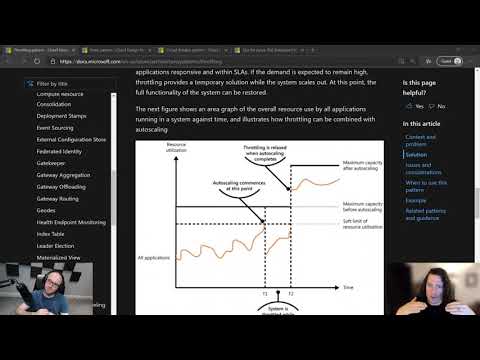
How do you protect your infrastructure from traffic spikes, safeguard multi-tenant workloads from noisy neighbours, and handle transient failures gracefully? Chris and John Downs walk through three essential cloud resilience patterns: Throttling (protecting services from excess load via rate limiting and HTTP 429), Retry (handling transient faults with exponential backoff), and Circuit Breaker (preventing cascade failures). Part of the "Architecting for the Cloud, One Pattern at a Time" series — essential viewing for any developer building on Azure.
GitHub Actions and Azure - Deploying ARM templates with GitHub Actions
Before deploying application code, you need cloud infrastructure in place. This episode demonstrates how to deploy Azure infrastructure using ARM templates (Infrastructure as Code) directly from a GitHub Actions workflow—covering ARM template structure, the azure/arm-deploy action, repository organisation, and service principal setup for automated, repeatable Azure deployments.

GitHub Actions and Azure - Deploying .NET Core code to Azure App Service
You have your .NET Core application code and your Azure App Service infrastructure is ready. Now it's time to wire them together with an automated GitHub Actions deployment pipeline. This episode walks through building a multi-job workflow that compiles, publishes, and deploys your .NET Core app to Azure App Service using publish profiles and GitHub Secrets.

GitHub Actions and Azure - Source Controlling our Code using Git
This series opener demonstrates source-controlling a .NET MVC project scaffolded with dotnet new mvc inside Windows Subsystem for Linux, using VS Code's built-in Git integration to stage commits, push to a new GitHub repository, and set a remote origin. It also introduces the GitHub Actions Azure Actions catalogue — including azure/login, azure/cli, and azure/webapps-deploy — as a foundation for the CI/CD automation covered in subsequent episodes.
GitHub Actions and Azure - Getting started with GitHub Actions and Azure Login
New to GitHub Actions? This episode is your starting point. Chris walks through GitHub Actions workflow fundamentals—YAML syntax, jobs, steps, GitHub-hosted runners, and secrets management—then shows how to authenticate against Azure using the Azure Login action and a service principal, before running Azure CLI commands as part of your first automated pipeline.
16 - The Backends for Frontends and Strangler Pattern with Peter Piper
Managing APIs across web, mobile, and multiple consumer types creates tight coupling that slows modernisation and makes versioning painful. In this episode, Chris Reddington is joined by Peter Piper to explore the Backend for Frontends (BFF) pattern — creating dedicated backends tailored to each consumer — alongside the Strangler Fig pattern for incrementally migrating legacy monoliths without disrupting existing clients. The Façade pattern also features as a key decoupling mechanism for smooth API migrations. Part of the "Architecting for the Cloud, One Pattern at a Time" series.
15 - The Sharding and Index Table Patterns
Concerned about the scalability of your data layer, or do you need data segregation for customers with regional data residency requirements? The Sharding pattern addresses exactly these challenges. If you are using a NoSQL data store without native secondary index support, the Index Table pattern provides an elegant solution for efficient querying. In this episode, Chris is joined by Steph Martin to explore both patterns in depth: shard key strategies (lookup, range, hash), cross-shard query design, the Azure SQL Database elastic client library, and how the Index Table pattern solves query efficiency challenges in stores like Cassandra and Cosmos DB.