Cloud Design Patterns
16 - The Backends for Frontends and Strangler Pattern with Peter Piper
Managing APIs across web, mobile, and multiple consumer types creates tight coupling that slows modernisation and makes versioning painful. In this episode, Chris Reddington is joined by Peter Piper to explore the Backend for Frontends (BFF) pattern — creating dedicated backends tailored to each consumer — alongside the Strangler Fig pattern for incrementally migrating legacy monoliths without disrupting existing clients. The Façade pattern also features as a key decoupling mechanism for smooth API migrations. Part of the "Architecting for the Cloud, One Pattern at a Time" series.
15 - The Sharding and Index Table Patterns
Concerned about the scalability of your data layer, or do you need data segregation for customers with regional data residency requirements? The Sharding pattern addresses exactly these challenges. If you are using a NoSQL data store without native secondary index support, the Index Table pattern provides an elegant solution for efficient querying. In this episode, Chris is joined by Steph Martin to explore both patterns in depth: shard key strategies (lookup, range, hash), cross-shard query design, the Azure SQL Database elastic client library, and how the Index Table pattern solves query efficiency challenges in stores like Cassandra and Cosmos DB.
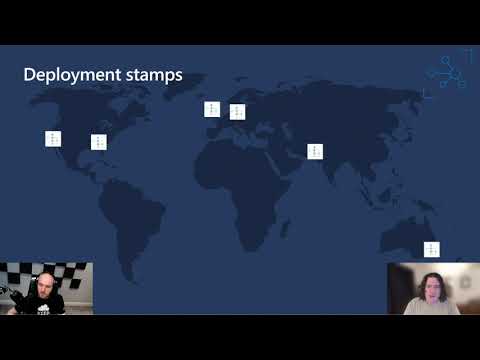
14 - The Deployment Stamps Pattern
The Deployment Stamps pattern is a powerful cloud architecture approach for scaling, resilience, and multi-tenancy. In this episode, Chris Reddington is joined by John Downs — who contributed the pattern to the Azure Architecture Center — to explore how stamping out independent copies of your application stack across regions enables geographic distribution, data sovereignty, isolated failure domains, and deployment rings for staged rollouts. Discover when to use this pattern, how Azure itself relies on it internally, and the key considerations around request routing, cross-stamp querying, and disaster recovery planning.

13 - Tales from the Real World - Defying DDOS
DDoS attacks have scaled to cloud-level volumes — terabits per second — that on-premises hardware simply cannot absorb. In this episode, Chris is joined by Cam Adams, an engineering manager from Brisbane, Australia, who shares first-hand experience helping customers across Asia-Pacific defend against distributed denial-of-service attacks using Azure. Whether workloads are fully in the cloud, in a hybrid state, or entirely on-premises, Cam explains how Azure can act as a scalable, cloud-powered defensive layer — and why the time to act is before an attack hits, not after.

9 - Building smart Integration Solutions with Microsoft Azure
Building cloud integration solutions means choosing the right messaging and eventing tools — and understanding the critical difference between an event and a message. In this episode, Chris is joined by Ezhilarasi Chezhiyan, Technical Lead at Serverless360 (Kovai.co), to explore Azure's serverless integration landscape: Logic Apps, Azure Functions, Service Bus, Event Grid, and Event Hubs. The discussion covers cloud design patterns including queue-based load leveling, competing consumers, dead letter queues, retry policies, and circuit breakers — plus the observability gap that tools like Serverless360 fill when Azure Monitor falls short for business-level monitoring.

5 - The API Economy
APIs are the connective tissue of modern cloud architectures — but poor API design compounds into technical debt that is expensive to unwind. In this episode, Chris Reddington and Peter Piper explore the full lifecycle of API design: defining versioning contracts up front, modernising legacy APIs using the Strangler and Façade patterns, and securing APIs with JWT tokens, OAuth 2.0, and OIDC. They also cover Azure API Management patterns, circuit breakers, throttling, key rotation with Azure Key Vault, and the DevSecOps practices that keep an API estate healthy at scale.

2 - Cost Control
Moving to the cloud shifts infrastructure spend from capital expenditure (CapEx) to operational expenditure (OpEx)—but only if you think about cost correctly from the start. This episode covers the cloud cost mindset: right-sizing, auto-scaling (scale out vs scale up), compute resource consolidation, governance through resource tagging and policy, pricing calculators, reserved instances, and how to build cost awareness into your architecture from day one.

1 - Requirements in Context
Every cloud project starts with requirements. In this episode, Chris explores the critical pillars of cloud architecture: resilience (SLA, RTO, RPO, MTTR, MTBF), scalability, performance, and cost. Learn why defining requirements upfront—before drawing architecture diagrams—is essential, and how the same on-premises thinking about availability translates directly into the cloud.
There are no clear architecture patterns for the Cloud? (Azure Mythbusters)

Cloud design patterns are abundant and well-documented on the Azure Architecture Center — from established patterns like cache-aside and materialized view to cloud-native ones like circuit breaker and health endpoint monitoring. This Azure Mythbusters episode tours the full pattern catalogue and deep-dives four key patterns: cache-aside, circuit breaker (open/half-open/closed states), health endpoint monitoring, and materialized view in CQRS/event sourcing scenarios.

Azure Myth 3: You don’t need requirements in the Cloud… Or do you? - Azure MythBusters
Requirements remain essential when migrating to or building on Azure — from availability SLAs and RPO/RTO targets to compliance, data sovereignty, and cost. This Azure Mythbusters episode uses composite SLA calculations and Azure Architecture Center reference architectures to show how under- or over-specifying requirements directly shapes your design, region strategy, and overall cost.