Containers
Cloud Drops - Introduction to GitHub Codespaces
Have you ever had to setup a development environment from scratch? You have to install a ton of dependencies, probably a few tools along the way as well. It's not fun, it takes a lot of time and it prevents you from being productive. This is where GitHub Codespaces comes in.

29 - The Sidecar and Ambassador Patterns
When modernising a legacy application, rewriting everything from scratch is rarely feasible. The Sidecar and Ambassador cloud design patterns offer a pragmatic alternative — attach a companion process to offload cross-cutting concerns like retry logic, circuit breaking, and protocol translation without modifying the application itself. Chris and Peter explore both patterns in depth, covering when to use each, how they relate to service meshes, and their role in Kubernetes-based architectures.

27 - The Compute Resource Consolidation Pattern (Optimise for Cost!)
Are you running dedicated compute for every tenant, microservice, or application instance — and paying for it? The Compute Resource Consolidation pattern shows you how to consolidate tasks onto shared infrastructure, such as a single AKS cluster with namespace isolation or an Azure SQL elastic pool, to reduce costs and management overhead. This episode explores the key trade-offs: blast radius containment, noisy neighbour contention, scalability profiles, and multi-tenancy strategies. Part of the "Architecting for the Cloud, One Pattern at a Time" series.
GitHub Codespaces, Visual Studio Code and Remote Containers
 Cloud with Chris
Setting up a development environment—installing the right SDK versions, extensions, and tools—wastes hours and causes 'works on my machine' problems. This episode shows how VS Code's Remote Containers extension and GitHub Codespaces solve this with containerised, reproducible dev environments defined in a devcontainer.json file. See a live demo of editing cloudwithchris.com entirely in a browser-based Codespace.
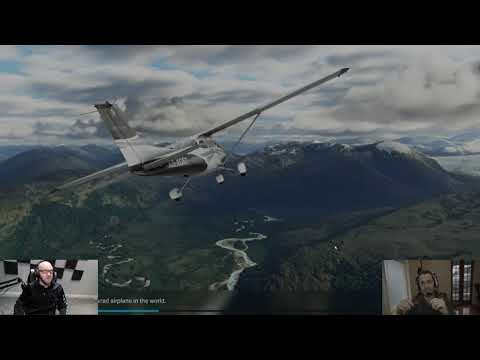
18 - Tales from the Real World - Defying Gravity.. The magic behind Flight Simulator 2020
What's actually powering Microsoft Flight Simulator 2020 — and what can cloud architects learn from it? Chris Reddington takes to the virtual skies over Queensland with former colleague Cam Adams, flying a Cessna 172 from Archerfield aerodrome while discussing the real Azure services behind one of the most technically ambitious games ever made. From CDN-based asset distribution and event-driven live weather to PlayFab game backends and DDoS protection — this is cloud architecture on the fly.
6 - Hybrid Cloud
Hybrid cloud is no longer just a transitional state between on-premises and public cloud — for many enterprises, it is the end state. Chris is joined by Thomas Maurer, Senior Cloud Advocate at Microsoft, to explore how Azure Arc, Azure Stack Hub, Azure Stack HCI, and Azure IoT Edge help organisations run workloads wherever they make sense: from data centres and factory floors to the network edge and other cloud providers.
I can use any Azure Compute Service to solve any problem? (Azure Mythbusters)

Choosing the wrong Azure compute service leads to mismatched scaling behaviour, cost overruns, and avoidable management overhead. This Azure Mythbusters episode compares App Service, App Service Environment, Container Instances, AKS, Service Fabric, Azure Batch, Azure Functions, Logic Apps, Virtual Machines, and VM Scale Sets — highlighting decision factors such as stateful versus stateless workloads, latency requirements, compliance needs, and auto-scale granularity.