Developer Experience

Rubber Duck Thursdays - Building a scoring system
 GitHub
Chris introduces OctoSnap, a GitHub-themed memory card game built with Next.js, and dives deep into designing a scoring model with Copilot covering difficulty multipliers, time bonuses, and penalty mechanics.
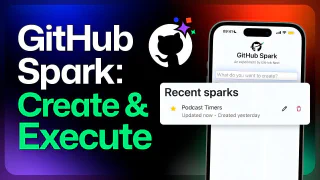
Use GitHub Spark to create a podcast timer apps
GitHubDemonstrates GitHub Spark on mobile, building a podcast session timer app entirely through natural language prompts. The video covers iteratively adding timer controls (start, pause, reset), a reverse progress bar, a color-coded time-remaining indicator (green/amber/red), and AI-powered timer creation from a plain-language description—showcasing GitHub Spark's built-in LLM integration. It also demonstrates Spark's managed state storage and the share link for giving collaborators read or write access.
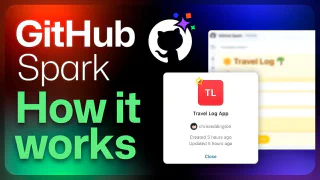
Use GitHub Spark to create a travel log app
GitHubDemonstrates GitHub Spark, an AI-native micro-app platform from GitHub Next that lets anyone build, use, and share personalized apps through natural language—without writing code or managing deployments. The video creates a city travel log app that captures reviews with GPS coordinates, plots destinations on a map, generates AI city suggestions based on existing ratings, and uses the variant generator to explore alternate UI directions from an ambiguous prompt. It also covers the built-in theme editor, state management, and revision history for iterating on app design.
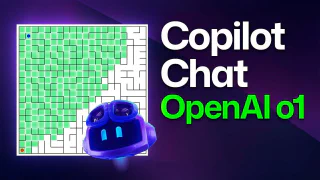
GitHub Copilot Chat and o1-preview: Building a maze generator!
GitHubDemonstrates the o1-preview reasoning model integrated into GitHub Copilot Chat in Visual Studio Code, available to approved users via the chat model picker alongside GPT-4o and o1 mini. The video builds a JavaScript maze generator that supports keyboard navigation, BFS and DFS solving algorithms, and visual path rendering—using o1-preview's extended internal reasoning to satisfy complex multi-requirement prompts in fewer iterations than standard models.
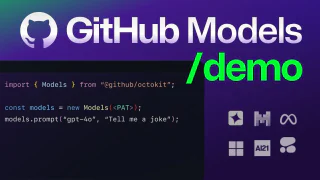
GitHub Models
GitHubIntroduces GitHub Models on the GitHub Marketplace, a curated playground for exploring and comparing a range of top AI models using entitlements tied to your GitHub account. The video demos GPT-4o and phi-3 mini instruct side-by-side, shows how to tune system prompts and temperature in the interactive playground, and demonstrates calling model APIs from GitHub Codespaces and the GitHub CLI—all without requiring separate API keys or service sign-ups.
Code from your phone with Github Copilot Workspace
GitHubShows GitHub Copilot Workspace running on the GitHub mobile app, allowing developers to capture ideas and iterate on code from a phone or tablet. The video covers using device dictation for task input, reviewing and editing the AI-generated specification and plan, inspecting code changes via the built-in diff view, running unit tests from the integrated terminal, and creating a pull request with an auto-generated description—all from a mobile device.
How to use Copilot Workspace for inspiration
GitHubDemonstrates GitHub Copilot Workspace starting from a template repository to scaffold a to-do application, showing how AI can jumpstart creativity when starting a new project. The video walks through the full specification-to-plan workflow, iterating with a live app preview, and switching between Copilot Workspace and GitHub Codespaces to make direct code edits. It also covers the share feature for collaborating on work in progress and the automated first deployment via GitHub Actions.

Rapid Prototyping as a way to validate your idea
Rapid prototyping is more than quick coding — it is a structured discipline for learning fast and making smarter product investment decisions. In this episode, Chris is joined by Andrew Greenstein, CEO of SF AppWorks and host of "The Next Great Thing" podcast, to explore three distinct types of rapid prototyping: design sprints, iterative feature development, and platform proof-of-concepts. The conversation draws on Kent Beck's product development triathlon (explore, expand, extract), Saras Saraswathy's effectuation theory, and a West Elm innovation case study — where rapid prototyping an AI image-matching feature and a chatbot delivered measurable revenue gains.

ClickOps over GitOps
The gap between raw Kubernetes and a developer-friendly platform is where the most interesting tooling is being built today. GitOps gives teams a declarative, version-controlled way to manage their clusters — but the YAML expertise and infrastructure knowledge required can be a steep barrier for developers. In this episode, Chris is joined by Laszlo Folgas, founder of Gimlet.io, to explore ClickOps over GitOps: a UI-driven deployment approach where developers click their way to production while the platform silently generates GitOps manifests and commits them to a Git repository. They cover Flux CD, how Gimlet's opinionated platform works end-to-end, and why developer experience has become the defining battleground in the cloud-native ecosystem.
ToolUp Days #15
Chris and Matt pick up inside GitHub Codespaces, getting the Player State service running locally on the first attempt thanks to Dapr's environment-variable secret store and Codespaces secrets. They then wire up the World Events Engine with Azure Storage Queue bindings and Table Storage state before hitting a stubborn .NET minimal API routing bug — becoming the cliffhanger that sets up the next session.