Enterprise
23 - Gatekeeper and Valet Key Patterns - Secure your APIs and Resources
Continuing the 'Architecting for the Cloud, one pattern at a time' series, Chris and Peter Piper explore two closely related cloud design patterns for securing APIs and backend resources. The Gatekeeper pattern positions a dedicated host between untrusted clients and trusted backend services — handling authentication, authorization, request validation, protocol translation, and rate limiting. The Valet Key pattern complements it by issuing short-lived, scope-restricted tokens (such as Azure SAS tokens) so clients can access specific resources directly, reducing load on central services without sacrificing security. The episode covers practical implementation options on Azure including API Management, Azure Key Vault, and Azure App Configuration.
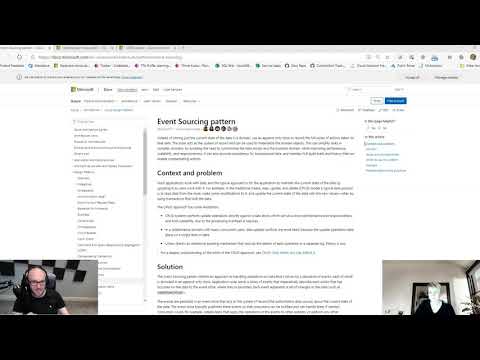
19 - The Event Sourcing, Materialized View and CQRS Patterns
What if you stored not just the current state of your data, but every event that produced it? The Event Sourcing pattern captures the full history of changes as an append-only log — enabling audit trails, temporal queries, and history replay. Combined with Materialized Views for efficient read-side querying and CQRS for command/query separation, these three patterns form a cornerstone of modern event-driven architecture. Chris and Steph explore all three in this episode of Architecting for the Cloud.
15 - The Sharding and Index Table Patterns
Concerned about the scalability of your data layer, or do you need data segregation for customers with regional data residency requirements? The Sharding pattern addresses exactly these challenges. If you are using a NoSQL data store without native secondary index support, the Index Table pattern provides an elegant solution for efficient querying. In this episode, Chris is joined by Steph Martin to explore both patterns in depth: shard key strategies (lookup, range, hash), cross-shard query design, the Azure SQL Database elastic client library, and how the Index Table pattern solves query efficiency challenges in stores like Cassandra and Cosmos DB.
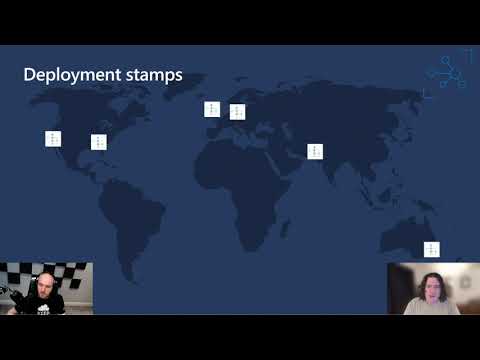
14 - The Deployment Stamps Pattern
The Deployment Stamps pattern is a powerful cloud architecture approach for scaling, resilience, and multi-tenancy. In this episode, Chris Reddington is joined by John Downs — who contributed the pattern to the Azure Architecture Center — to explore how stamping out independent copies of your application stack across regions enables geographic distribution, data sovereignty, isolated failure domains, and deployment rings for staged rollouts. Discover when to use this pattern, how Azure itself relies on it internally, and the key considerations around request routing, cross-stamp querying, and disaster recovery planning.

13 - Tales from the Real World - Defying DDOS
DDoS attacks have scaled to cloud-level volumes — terabits per second — that on-premises hardware simply cannot absorb. In this episode, Chris is joined by Cam Adams, an engineering manager from Brisbane, Australia, who shares first-hand experience helping customers across Asia-Pacific defend against distributed denial-of-service attacks using Azure. Whether workloads are fully in the cloud, in a hybrid state, or entirely on-premises, Cam explains how Azure can act as a scalable, cloud-powered defensive layer — and why the time to act is before an attack hits, not after.

6 - Hybrid Cloud
Hybrid cloud is no longer just a transitional state between on-premises and public cloud — for many enterprises, it is the end state. Chris is joined by Thomas Maurer, Senior Cloud Advocate at Microsoft, to explore how Azure Arc, Azure Stack Hub, Azure Stack HCI, and Azure IoT Edge help organisations run workloads wherever they make sense: from data centres and factory floors to the network edge and other cloud providers.

4 - Hackathons
Hackathons are a powerful accelerator for learning, innovation, and community building — but what does it actually take to participate in, organize, or mentor at one? In this episode, Chris is joined by Maria Vrabie, an experienced hackathon participant, organizer, and mentor with a background at Microsoft. They explore the full spectrum of hackathon formats: from university weekend events and charity hack days to corporate open hacks run with enterprise customers. Maria shares candid stories from both sides of the organizer table, practical advice for first-timers, and why hackathons are just as relevant for seasoned engineers as they are for students looking to break into tech.

3 - DevOps in a Cloud World
DevOps is the union of people, process, and products to enable the continuous delivery of value to end users — not just code or features. In this episode, Abel Wang, Principal Developer Advocate and DevOps Lead at Microsoft, joins Chris to cover the foundations of DevOps, telemetry-driven development, database DevOps, feature flags, Site Reliability Engineering, and the importance of shifting left on quality and security.

2 - Cost Control
Moving to the cloud shifts infrastructure spend from capital expenditure (CapEx) to operational expenditure (OpEx)—but only if you think about cost correctly from the start. This episode covers the cloud cost mindset: right-sizing, auto-scaling (scale out vs scale up), compute resource consolidation, governance through resource tagging and policy, pricing calculators, reserved instances, and how to build cost awareness into your architecture from day one.

1 - Requirements in Context
Every cloud project starts with requirements. In this episode, Chris explores the critical pillars of cloud architecture: resilience (SLA, RTO, RPO, MTTR, MTBF), scalability, performance, and cost. Learn why defining requirements upfront—before drawing architecture diagrams—is essential, and how the same on-premises thinking about availability translates directly into the cloud.