Event-Driven Architecture
26 - The Pub Sub, Priority Queue and Pipes and Filter Patterns
Chris Reddington and Will Eastbury cover three closely related messaging patterns in one packed episode. They start with the Publish-Subscribe (Pub/Sub) pattern — arguably the most transformative shift in enterprise messaging — where a single producer broadcasts to multiple isolated subscribers via Azure Service Bus topics or Azure Event Grid. Real-world use cases include insurance aggregators, credit check pipelines, and bank account sign-up workflows. From there they move to the Priority Queue pattern, which ensures high-priority messages are processed before lower-priority ones even when consumers are under load. Finally, the Pipes and Filters pattern decomposes complex message processing into a chain of discrete, reusable transformation steps — reducing complexity and enabling independent scaling of each stage. The episode also connects these patterns back to earlier topics like Competing Consumers and Queue-Based Load Leveling, and flags related patterns including Choreography and Compensating Transactions.
V006 - Weekly Technology Vlog #6 (Recap, Coming Up and NEWS!)
Chris hosts the first live weekly vlog, recapping the Cloud Gaming Notes debut and a candid mental health conversation with Andrew Nathan. He covers Azure Security Center updates including dangling DNS protection for Azure Defender and the secure score API GA, spotlights Project Bicep as a new ARM template authoring experience with a VS Code extension, and highlights GitHub's engineering post on SLO-based deployment pipeline reliability.
21 - The Queue Based Load Levelling and Competing Consumers Pattern
 Cloud with Chris
Do you have an application with specific scalability and continuity-of-service requirements? What happens when traffic spikes dramatically — think a major concert or FIFA World Cup ticket sale crashing a site? In this Architecting for the Cloud episode, Chris and Will Eastbury walk through three closely related patterns: Queue-Based Load Levelling, Competing Consumers, and the Asynchronous Request-Reply pattern. They explore how message queues act as shock absorbers for traffic spikes, how competing consumers enable elastic horizontal scaling, and how async request-reply lets you retrofit these patterns into existing architectures with minimal disruption. Key trade-offs covered include queue depth limits, Azure Service Bus configuration, distributed tracing with Application Insights, and when the added complexity genuinely justifies reaching for these patterns.
19 - The Event Sourcing, Materialized View and CQRS Patterns
What if you stored not just the current state of your data, but every event that produced it? The Event Sourcing pattern captures the full history of changes as an append-only log — enabling audit trails, temporal queries, and history replay. Combined with Materialized Views for efficient read-side querying and CQRS for command/query separation, these three patterns form a cornerstone of modern event-driven architecture. Chris and Steph explore all three in this episode of Architecting for the Cloud.
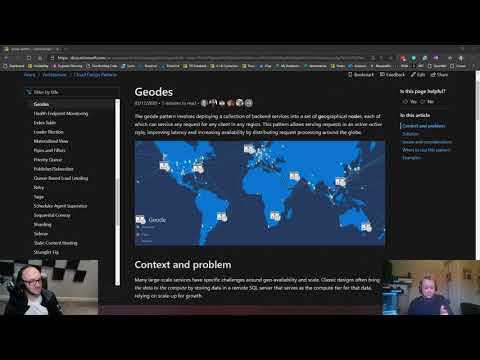
11 - The Geode Pattern - What is it and how can it be useful for my app?
You may know patterns like Retry, Circuit Breaker, or Deployment Stamps — but have you heard of the Geode pattern? In this Architecting for the Cloud episode, Chris and Will Eastbury (who contributed to the original Azure Architecture Center documentation for this pattern) explore how Geodes enable planet-scale, active-active applications where every node can serve any user from any region. Unlike Deployment Stamps (which are tenant-scoped), Geodes replicate data across all regions, eliminating active-passive compute wastage and delivering consistent low-latency experiences globally. The session covers key trade-offs around data sovereignty, replication costs, and the evolution toward intelligent edge deployments — and includes a walkthrough of a globally distributed real-time voting app built with Azure Functions, Cosmos DB, and SignalR.
18 - Tales from the Real World - Defying Gravity.. The magic behind Flight Simulator 2020
What's actually powering Microsoft Flight Simulator 2020 — and what can cloud architects learn from it? Chris Reddington takes to the virtual skies over Queensland with former colleague Cam Adams, flying a Cessna 172 from Archerfield aerodrome while discussing the real Azure services behind one of the most technically ambitious games ever made. From CDN-based asset distribution and event-driven live weather to PlayFab game backends and DDoS protection — this is cloud architecture on the fly.

9 - Building smart Integration Solutions with Microsoft Azure
Building cloud integration solutions means choosing the right messaging and eventing tools — and understanding the critical difference between an event and a message. In this episode, Chris is joined by Ezhilarasi Chezhiyan, Technical Lead at Serverless360 (Kovai.co), to explore Azure's serverless integration landscape: Logic Apps, Azure Functions, Service Bus, Event Grid, and Event Hubs. The discussion covers cloud design patterns including queue-based load leveling, competing consumers, dead letter queues, retry policies, and circuit breakers — plus the observability gap that tools like Serverless360 fill when Azure Monitor falls short for business-level monitoring.
An Introduction to Azure Functions
If you have been keeping up to date with the latest and greatest in Azure Services (yes, I know there are quite a few!), you may have heard of a new service called Azure Functions. Azure Functions is an event-driven Platform as a Service capability, helping you to execute code upon the occurrence of a particular event. It is currently in preview, though already has a lot of potential.