GitHub Actions

Rubber Duck Thursdays - Lizard, Spock
 GitHub
Extending Rock Paper Scissors to include Lizard and Spock using GitHub Copilot Vision to interpret a game diagram. Also covers Claude 3.7 Sonnet in Copilot, Dependabot version updates for Go modules, GitHub Codespaces for testing, and repository branch protection settings.

Rubber Duck Thursdays - Rock, Paper, Scissors
GitHubBuilding a Rock Paper Scissors game in Go for the gh-game GitHub CLI extension using GitHub Copilot Agent Mode. Explores the new GPT-4o code completion model, Next Edit Suggestions, and drives test coverage from 42% to 100% using Copilot inline chat and agent workflows.

Rubber Duck Thursdays - Tic, Tac, Toe
GitHubBuilding a Tic Tac Toe game in Go for the gh-game GitHub CLI extension using GitHub Copilot Agent Mode. Also covers setting up CodeQL code scanning, fixing GitHub Actions workflow permissions, and a demo of GitHub Spark for creating micro apps from natural language prompts.

Rubber Duck Thursdays - Actions, Codespaces and Coin Toss
GitHubBuilding on the gh-game CLI extension project, Chris sets up GitHub Codespaces with dev containers, creates a CI workflow using GitHub Actions, and writes Go tests. The stream covers refactoring the coin toss game to use the go-gh prompter package for interactive selection menus, with GitHub Copilot assisting across multiple AI models.

Rubber Duck Thursdays - Creating gh-game CLI extension
GitHubDeep dive into GitHub Actions workflows including build, linter, and release pipelines for the GitHub Skyline CLI extension. Chris cuts a live release, then creates a brand new GitHub CLI extension (gh-game) from scratch — building a coin toss game in Go using the Cobra package with help from GitHub Copilot.
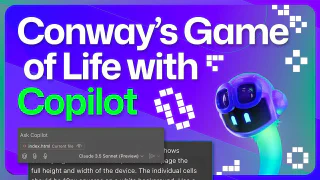
Build Conway's Game of Life with GitHub Copilot Free
GitHubBuilds Conway's Game of Life end-to-end using GitHub Copilot Chat and Copilot Edits in Visual Studio Code, demonstrating a realistic iterative AI-assisted development workflow. The video covers model selection (including Claude Sonnet 3.5), prompt engineering best practices, refactoring from a single-file prototype to separate HTML, CSS, and JavaScript files using Copilot Edits, and enforcing team coding standards with a Copilot instructions file. It also shows inline chat slash commands (/doc, /explain), Copilot Extensions, README generation, and deploying to GitHub Pages via a GitHub Actions workflow.
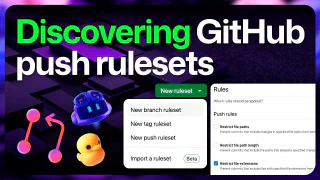
Govern your repositories with push rulesets
GitHubIntroduces GitHub push rulesets, a governance feature that restricts what can be pushed to a repository based on the attributes of changed files—including path, extension, and size. The video demonstrates protecting sensitive files such as GitHub Actions workflow files, configuring bypass rules for designated roles, viewing blocked-push and bypass insights, and explains that push rules are enforced across the entire fork network of a repository.
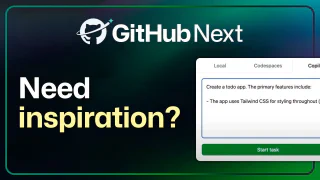
How to use Copilot Workspace for inspiration
GitHubDemonstrates GitHub Copilot Workspace starting from a template repository to scaffold a to-do application, showing how AI can jumpstart creativity when starting a new project. The video walks through the full specification-to-plan workflow, iterating with a live app preview, and switching between Copilot Workspace and GitHub Codespaces to make direct code edits. It also covers the share feature for collaborating on work in progress and the automated first deployment via GitHub Actions.

Beyond version control: Using GitHub throughout your development lifecycle
GitHub is well-known for version control, and its work with the open source community. But did you know you can use GitHub throughout your development lifecycle? Join Chris Reddington from GitHub's Developer Relations team as he explores how you can use GitHub to plan, code, build, and deploy your work. Learn how the platform comes together in GitHub Issues, Projects, Codespaces, Actions, Copilot and Advanced Security!
Automate Azure infrastructure change reviews by using Bicep and GitHub

Add checks to pull requests that run automatically during your code reviews. Run the Bicep linter on your code, and deploy the resources to a temporary environment to enable further automated and manual testing.