Go
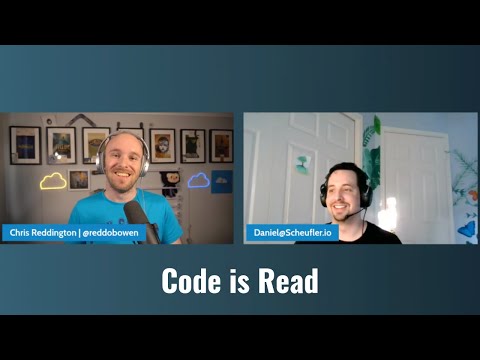
Code is Read
What separates code that teams maintain with confidence from code that becomes an unmaintainable burden? Chris is joined by Daniel Schreifler — developer, consultant, and author of "10 Days to Become a Better Developer" — to explore why readability is the most foundational software quality. From cognitive load and the early-exit pattern to domain-driven naming, inner sourcing, and TDD, this conversation reframes how we should think about writing code: not for the compiler, but for the next human who needs to change it.
ToolUp Tuesday - #9
Chris and Matt debug deployment issues in Azure Container Apps, restructure their Bicep infrastructure as code into separate lifecycles, and configure Dapr state store components backed by Azure Storage.
ToolUp Tuesday - #7
Chris and Matt containerize their Go microservices by writing Dockerfiles, building images, and publishing them to GitHub Packages container registry using GitHub Actions workflows with GITHUB_TOKEN authentication.
Using GitHub Actions to summarise your Go tests
GitHub recently posted about a new GitHub Action that can be used to summarise your test results. The action is called test-summary/action, available at github.com/test-summary/action. There are several examples on how to use the action at github.com/test-summary/examples. However, there were no examples on how to use this with Go. I contributed a pull request which showed how to achieve this. In this post, I will show how to use the action with Go.
Interfaces in Go
In this post, I'll be talking about how to use interfaces in Go. This is a continuation of my learning using the Go language. I'll use interfaces to create an application that interacts with several types of bank accounts.
ToolUp Tuesday - #6
Chris and Matt wire up Dapr state management for their .NET player state service, configure VS Code debugging for multi-service development, and document game use cases covering player enrollment, world event ticks, and decision lifecycle.
Go Pointers - Using the & and * operators
I'll be transparent. The purpose of this post is to help with my own understanding of the Go & and * operators. It's going to be a very short post, and I'm going to try to explain the concepts in a way that I can understand. I've used these operators in C previously, but whenever I'm using them - I always end up having to remember the syntax / which operator is which / what they do. For whatever reason, it doesn't always come intuitively to me.
Set up your Go development environment with Visual Studio Code and Windows Subsystem for Linux (WSL)
Over the past few weeks, I have been working on a new set of pet projects. I've wanted to learn Go for a while, so I thought this could be a great opportunity to get hands on and try it out. It's fair to say that my development environment was 'functional', but I wanted to revisit it to make sure that I could get the best out of it. In this blog post, I'm going to walkthrough the process of setting up Go on my machine, and then the experience of using Visual Studio Code and Windows Subsystem for Linux (WSL) with Ubuntu.
ToolUp Tuesday - #5
Chris and Matt refactor their Go player decisions API, restructuring packages and project layout. They compare the Gin and Gorilla Mux HTTP frameworks, explore Go interfaces and dependency injection patterns, and discuss unit testing and mocking strategies in Go.
ToolUp Tuesday - #4
Chris and Matt dive into Go (Golang) for the first time on stream, building a player decisions REST API for their game project. They explore Go fundamentals including structs, pointers, packages, and the Gin HTTP framework while comparing Go patterns to C# and .NET conventions.