Messaging
ToolUp Days #15
Chris and Matt pick up inside GitHub Codespaces, getting the Player State service running locally on the first attempt thanks to Dapr's environment-variable secret store and Codespaces secrets. They then wire up the World Events Engine with Azure Storage Queue bindings and Table Storage state before hitting a stubborn .NET minimal API routing bug — becoming the cliffhanger that sets up the next session.
ToolUp Days #12
Chris and Matt deploy the World Events Engine to Azure Container Apps — encountering and fixing a real-world GitHub Actions deployment bug caused by parallel runs generating duplicate container names. The episode covers Dapr storage queue bindings, service invocation between microservices, random bar-type modifier logic, and a viewer-prompted conversation about using GitHub Codespaces to standardise the development environment.
Microservices have communication issues, especially when they fail
Communication between microservices is one of the trickiest challenges in distributed systems — especially when things go wrong. In this episode, Chris is joined by Francesco, a software engineer building a real-world payment gateway, to explore microservices communication patterns. They dive deep into the Saga pattern for managing multi-step distributed transactions, covering orchestration-based Sagas with AWS Step Functions, compensating transactions for graceful rollbacks, and event-driven messaging via EventBridge. The conversation also covers observability in distributed systems and applying Occam's Razor to architecture decisions.
Enqueue and Dequeue messages locally with dapr, Azure Service Bus and Azure Storage Queues
In a previous blog post, I provided an overview of the Distributed Application Runtime (dapr) and explained how it is a useful framework when building microservices. In this blog post, I will show you how to use dapr to enqueue and dequeue messages locally with Azure Service Bus and Azure Storage Queues.
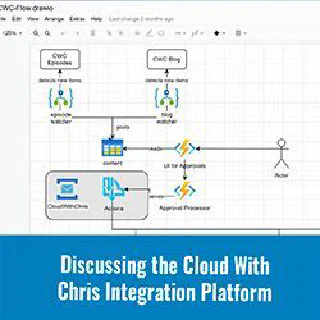
Discussing the Cloud with Chris Integration Platform
Chris is joined by Karl Cooke (IrishTechie.com) for a deep dive into the CloudWithChris.com integration platform — a real-world Azure integration architecture built to automate content distribution to Twitter, LinkedIn, Facebook, and Reddit, and to amplify updates from the Azure, GitHub, and Azure DevOps blogs. The session walks through the full architecture: Azure Functions, Azure Service Bus topics and queues, Azure Table Storage, Azure Logic Apps, and a Vue.js management UI, plus a custom URL shortener for per-platform analytics.
How I use Azure Integration Services on Cloud With Chris
I've written blog posts previously around Azure Service Bus vs Azure Storage Queues, as well as an introduction to Azure Logic Apps and how I used it at the time. Back then, my use-case was fairly rudimentary and focused on a specific scenario. In this blog post, I explain the changes that I have made and how I've used common cloud design / integration patterns to implement a more robust solution.
Azure Storage Queues vs Azure Service Bus Queues - Which should I use when?
I've recently been involved in a few integration focused discussions, where there is a requirement to bring together multiple separate systems. If you've been following the Architecting for the Cloud, one pattern at a time series, then you'll have heard Peter Piper repeat a common phrase - 'High Cohesion, Low Coupling'.
Cloud Drops - Building an Event-Driven workflow with Event Grid
Azure Event Grid routes blob-created events from Azure Storage to downstream handlers, enabling scalable event-driven pipelines where producers and consumers are fully decoupled. This Cloud Drop builds an end-to-end workflow using an Event Grid system topic, subject filtering, an Azure Storage Queue as the event handler, a system-managed identity with the Storage Queue Data Message Sender role, and an Azure Function queue trigger to process and remove each message.
V018 - Weekly Technology Vlog #18
Weekly Vlog #18 arrives on a UK Bank Holiday, covering Microsoft's acquisition of Kinvolk to accelerate cloud-native investment and the preview launch of Azure Web PubSub — a managed WebSocket service for real-time applications. Chris reviews Delivery Plans 2.0 GA in Azure DevOps and GitHub engineering posts on feature flags and mono-repo performance optimisations, then shares a detailed update on the Hugo CrossPoster open-source project now featuring unit tests, SonarCloud analysis, and Polly resilience patterns including circuit breakers and retry logic.
Introduction to Logic Apps
Many years ago, I wrote a blog post which introduced Logic Apps at a very high level when they were initially released. Ahead of a blog post that I want to write on Logic Apps v2, I thought that it may be worth writing a more thorough recap of Logic Apps as a platform. Logic Apps is a Platform as a Service (PaaS) offering, which allows you to easily build visual workflow integrations. Whether that's plumbing several microservices together, entirely different solutions within an enterprise, or some of the repetitive backend administrative tasks for a podcast or blog site, Logic Apps may be worth exploring.