Observability
V006 - Weekly Technology Vlog #6 (Recap, Coming Up and NEWS!)
Chris hosts the first live weekly vlog, recapping the Cloud Gaming Notes debut and a candid mental health conversation with Andrew Nathan. He covers Azure Security Center updates including dangling DNS protection for Azure Defender and the secure score API GA, spotlights Project Bicep as a new ARM template authoring experience with a VS Code extension, and highlights GitHub's engineering post on SLO-based deployment pipeline reliability.
V005 - Weekly Technology Vlog #5 (My Setup, Architecture Patterns, Mental Health and NEWS)
Chris recaps the health endpoint monitoring pattern episode and a PC build blog, then previews the debut of Cloud Gaming Notes with Lee Williams on game server hosting, and a candid mental health conversation with Andrew Nathan. He reviews Azure updates including Azure Cloud Services Extended Support ARM-based deployment, Azure AD Premium 99.99% SLA, the Azure Architecture Center January digest, and GitHub engineering posts on canary deployment strategies and JavaScript performance optimisation.
24 - Health Endpoint Monitoring Pattern (Monitor your service and its dependencies!)
Stop waiting for users to tell you something is broken. The Health Endpoint Monitoring pattern gives your services a dedicated health-check endpoint that aggregates the status of all dependent components—databases, APIs, storage—into a single observable response. This episode covers the pattern in detail, including design considerations around caching, security, denial-of-service exposure, and integration with Azure Monitor and Application Insights.
V003 - Weekly Technology Vlog #3 (Contributing to OSS, Azure Thames Valley and Tech News)
Chris announces his involvement with relaunching the Azure Thames Valley meetup, recaps the static content hosting pattern episode and his open source blog, and previews upcoming talks at AzureIsh Live and a SquaredUp webinar on application observability with Azure Monitor and App Insights. He covers Azure Updates including public IP SKU upgrades, built-in Azure Policy for NSG flow logs, GitHub's availability in Iran, the GitHub Enterprise Server 3.0 release candidate, and Docker Desktop integration with Azure Container Instances.
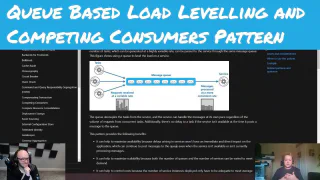
21 - The Queue Based Load Levelling and Competing Consumers Pattern
 Cloud with Chris
Do you have an application with specific scalability and continuity-of-service requirements? What happens when traffic spikes dramatically — think a major concert or FIFA World Cup ticket sale crashing a site? In this Architecting for the Cloud episode, Chris and Will Eastbury walk through three closely related patterns: Queue-Based Load Levelling, Competing Consumers, and the Asynchronous Request-Reply pattern. They explore how message queues act as shock absorbers for traffic spikes, how competing consumers enable elastic horizontal scaling, and how async request-reply lets you retrofit these patterns into existing architectures with minimal disruption. Key trade-offs covered include queue depth limits, Azure Service Bus configuration, distributed tracing with Application Insights, and when the added complexity genuinely justifies reaching for these patterns.
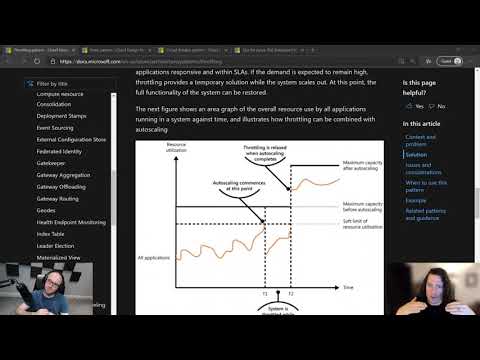
17 - The Throttling, Retry and Circuit Breaker Patterns
How do you protect your infrastructure from traffic spikes, safeguard multi-tenant workloads from noisy neighbours, and handle transient failures gracefully? Chris and John Downs walk through three essential cloud resilience patterns: Throttling (protecting services from excess load via rate limiting and HTTP 429), Retry (handling transient faults with exponential backoff), and Circuit Breaker (preventing cascade failures). Part of the "Architecting for the Cloud, One Pattern at a Time" series — essential viewing for any developer building on Azure.

13 - Tales from the Real World - Defying DDOS
DDoS attacks have scaled to cloud-level volumes — terabits per second — that on-premises hardware simply cannot absorb. In this episode, Chris is joined by Cam Adams, an engineering manager from Brisbane, Australia, who shares first-hand experience helping customers across Asia-Pacific defend against distributed denial-of-service attacks using Azure. Whether workloads are fully in the cloud, in a hybrid state, or entirely on-premises, Cam explains how Azure can act as a scalable, cloud-powered defensive layer — and why the time to act is before an attack hits, not after.
9 - Building smart Integration Solutions with Microsoft Azure
Building cloud integration solutions means choosing the right messaging and eventing tools — and understanding the critical difference between an event and a message. In this episode, Chris is joined by Ezhilarasi Chezhiyan, Technical Lead at Serverless360 (Kovai.co), to explore Azure's serverless integration landscape: Logic Apps, Azure Functions, Service Bus, Event Grid, and Event Hubs. The discussion covers cloud design patterns including queue-based load leveling, competing consumers, dead letter queues, retry policies, and circuit breakers — plus the observability gap that tools like Serverless360 fill when Azure Monitor falls short for business-level monitoring.
8 - Azure Security
Moving to Azure? Security has to come first. Chris is joined by cybersecurity expert Andrew Nathan to explore how organisations can build a strong security posture in the cloud — covering Azure Security Center and Secure Score, identity strategy (Azure AD vs. Azure RBAC), multi-factor authentication, threat modelling, Azure Policy and Management Groups for governance, and the evolution of security operations into red team/blue team war gaming. Whether you're starting your cloud journey or course-correcting an existing environment, this episode will help you understand where to begin and how to keep improving over time.
3 - DevOps in a Cloud World
DevOps is the union of people, process, and products to enable the continuous delivery of value to end users — not just code or features. In this episode, Abel Wang, Principal Developer Advocate and DevOps Lead at Microsoft, joins Chris to cover the foundations of DevOps, telemetry-driven development, database DevOps, feature flags, Site Reliability Engineering, and the importance of shifting left on quality and security.