
An introduction to Cloud, Azure and the Azure Portal
Related Content

38 - Hands-on with The Geode Pattern (Build globally distributed applications!)
Episode 11 covered the Geode pattern in theory — now it's time to get hands-on! Will Eastbury returns to walk through a real-world OData service deployed across three Azure regions (US West, Australia Southeast, and UK West), stitched together by Azure Front Door for active-active routing. Watch how Cosmos DB replicates data across all regions as a shared backplane, how health probes detect and remove unhealthy geodes from rotation, and the ASP.NET middleware pattern needed to handle URL rewriting — a critical authentication gotcha when hosting services behind a reverse proxy.
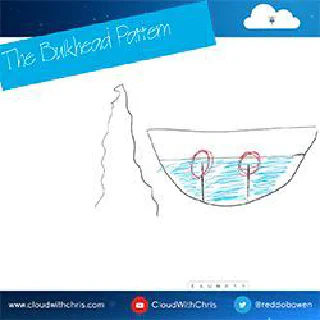
34 - The Bulkhead Pattern (Isolate your components to prevent failures)
The Bulkhead pattern takes its name from the watertight compartments in a ship's hull. Just as those compartments prevent a single breach from sinking the whole vessel, the Bulkhead pattern isolates components of a cloud application so that failures or resource exhaustion in one service cannot cascade to others. This episode covers partitioning strategies, connection pools, Kubernetes resource limits, and multi-tenancy considerations.

33 - External Config and Claim Check Pattern - Easier Management and Externalising Payloads
Chris and Peter cover two cloud design patterns in depth. The External Configuration Store pattern addresses one of the most critical security concerns in cloud development: keeping secrets and connection strings out of source code. They explore Azure Key Vault and Azure App Configuration as canonical implementations, discuss deployment slot behaviour, and highlight the risks of committing credentials to version control. The Claim Check pattern tackles a different challenge — what happens when your message payload exceeds the size limits of your messaging infrastructure (Azure Service Bus, Azure Queue Storage)? By externalising the payload to a data store and passing only a correlation ID on the queue, you gain scalability and flexibility at the cost of added latency. Azure Event Grid's automatic claim check generation is also demonstrated. Security is a thread running through both patterns: compromised config stores and poisoned messages both demand an operational response plan.