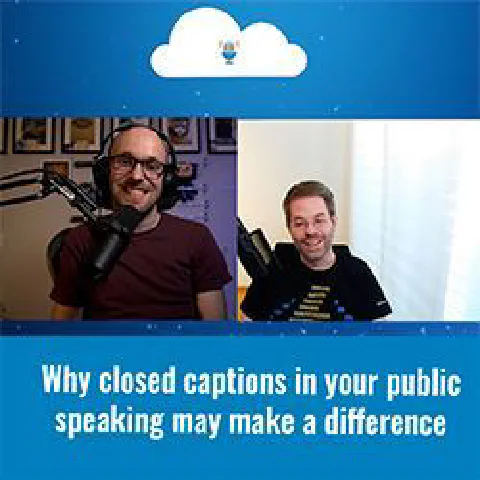
Why closed captions in your public speaking may make a difference
Hearing impairment isn’t a rare edge case — the WHO estimates over 430 million people worldwide experience some form of hearing loss, ranging from mild frequency-specific loss to complete deafness. Yet when it comes to public speaking, conferences, and online presentations, captions are still treated as optional. In this episode, Kai Saata — data consultant, cochlear implant user, and co-founder of two national associations in Switzerland — explains why that needs to change.
Why Captions Matter More Than You Think
Hearing loss exists on a spectrum. Some people have difficulty hearing certain frequencies; others, like Kai, are profoundly deaf and rely on implants that provide hearing — but not the same quality of hearing as a natural ear. In a noisy conference room, on a video call with compression artefacts, or watching a recording at reduced volume, captions can be the difference between inclusion and exclusion.
Cloud-Powered Captioning is Here Now
One of the key points Kai makes: this isn’t a future capability. Microsoft Teams and other modern platforms already offer real-time, AI-powered live transcription built on cloud machine learning. The technology exists — speakers just need to enable it and encourage its use. This is a direct example of cloud technology improving human accessibility at scale.
Practical Steps for Speakers
- Enable live captions in Microsoft Teams or your presentation platform.
- Speak clearly and at a measured pace — this improves both human comprehension and automated transcription accuracy.
- Treat accessibility as a first-class concern in your presentation preparation, not an afterthought.
Related Content
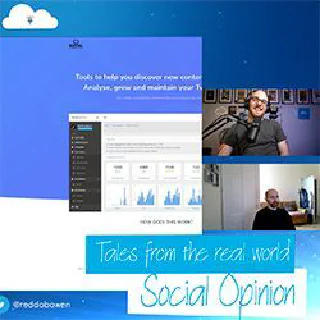
Social Opinion with Jamie Maguire
Have you ever wondered what it takes to build a production SaaS platform in your own time? In this Tales from the Real World episode, Chris is joined by Jamie Maguire — Developer, Microsoft MVP (AI), and Pluralsight Author — who shares the full story behind Social Opinion, a Twitter analytics and productivity platform built with .NET and Azure. Jamie walks through the evolution from a custom Bayesian text analytics API (built during his master's degree) to a full SaaS powered by Azure Cognitive Services, covering social listening, sentiment analysis, content scheduling, and audience insights. He also shares practical advice for anyone looking to build their own product: pick something you're genuinely passionate about, validate demand before writing code, and ship early.
V008 - Weekly Technology Vlog #8 (Changing Role, Guest Appearances, LOTS of Azure News)
Chris marks two months of weekly vlogging with a big career update: leaving FastTrack for Azure to become a Cloud Solution Architect in Microsoft's UK Customer Success Unit, focusing on the Manufacturing & Resources industry. The cloudwithchris.com site is also refreshed with a PodScribe-powered interactive transcript player that highlights spoken words in real time and enables crowd-sourced corrections — a meaningful accessibility improvement. Azure news is substantial this week, headlined by Azure RBAC for Key Vault data plane reaching GA (enabling secret- and certificate-level access control) and Azure Front Door Standard & Premium entering preview with private origin support via Private Link.
V032 - Talking cloud and playing Among Us with the community
A community Among Us stream with twelve cloud professionals discussing Kubernetes trade-offs in production, Windows 365 Cloud PC versus Azure Virtual Desktop, Azure Arc for multi-cloud app deployment, game engine choices between Unity and Unreal, and imposter syndrome in tech careers.