Cloud Drops - Beginners guide to PowerShell in Azure Functions
Azure Functions supports multiple runtime stacks — including PowerShell Core — meaning that operations teams already fluent in PowerShell can build serverless automation without switching to a compiled language. The consumption plan charges only per invocation with no idle cost, and Application Insights is enabled by default to provide monitoring and logging from day one.
The demo creates two functions inside a single Function App. The first uses an HTTP trigger with a simple run.ps1 that reads a query-string parameter and returns it in the response body, illustrating the input-binding and output-binding model. The second uses an Event Grid trigger connected to a subscription-level topic: whenever a resource group is created, the function fires and calls Set-AzResourceGroup to apply a cost-centre tag based on the environment value. Before the Az module commands work, you must declare the dependency in requirements.psd1 (under App Files) and restart the Function App. A system-assigned managed identity with the Contributor role on the subscription provides the necessary RBAC permissions without storing any credentials in code.
Related Content

9 - Building smart Integration Solutions with Microsoft Azure
Building cloud integration solutions means choosing the right messaging and eventing tools — and understanding the critical difference between an event and a message. In this episode, Chris is joined by Ezhilarasi Chezhiyan, Technical Lead at Serverless360 (Kovai.co), to explore Azure's serverless integration landscape: Logic Apps, Azure Functions, Service Bus, Event Grid, and Event Hubs. The discussion covers cloud design patterns including queue-based load leveling, competing consumers, dead letter queues, retry policies, and circuit breakers — plus the observability gap that tools like Serverless360 fill when Azure Monitor falls short for business-level monitoring.
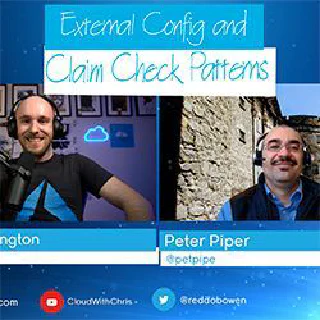
33 - External Config and Claim Check Pattern - Easier Management and Externalising Payloads
Chris and Peter cover two cloud design patterns in depth. The External Configuration Store pattern addresses one of the most critical security concerns in cloud development: keeping secrets and connection strings out of source code. They explore Azure Key Vault and Azure App Configuration as canonical implementations, discuss deployment slot behaviour, and highlight the risks of committing credentials to version control. The Claim Check pattern tackles a different challenge — what happens when your message payload exceeds the size limits of your messaging infrastructure (Azure Service Bus, Azure Queue Storage)? By externalising the payload to a data store and passing only a correlation ID on the queue, you gain scalability and flexibility at the cost of added latency. Azure Event Grid's automatic claim check generation is also demonstrated. Security is a thread running through both patterns: compromised config stores and poisoned messages both demand an operational response plan.

26 - The Pub Sub, Priority Queue and Pipes and Filter Patterns
Chris Reddington and Will Eastbury cover three closely related messaging patterns in one packed episode. They start with the Publish-Subscribe (Pub/Sub) pattern — arguably the most transformative shift in enterprise messaging — where a single producer broadcasts to multiple isolated subscribers via Azure Service Bus topics or Azure Event Grid. Real-world use cases include insurance aggregators, credit check pipelines, and bank account sign-up workflows. From there they move to the Priority Queue pattern, which ensures high-priority messages are processed before lower-priority ones even when consumers are under load. Finally, the Pipes and Filters pattern decomposes complex message processing into a chain of discrete, reusable transformation steps — reducing complexity and enabling independent scaling of each stage. The episode also connects these patterns back to earlier topics like Competing Consumers and Queue-Based Load Leveling, and flags related patterns including Choreography and Compensating Transactions.