
18 - Tales from the Real World - Defying Gravity.. The magic behind Flight Simulator 2020
Flight Simulator 2020 is more than a game — it’s a globally distributed cloud application delivering photorealistic terrain, live weather, and real-time multiplayer to millions of users simultaneously. In this episode, Chris and Cam use an actual flight in the simulator as a vehicle for exploring the cloud architecture behind it.
Topics covered during the flight include:
- Content distribution at scale: How a 150 GB game download reaches players on launch day — Azure Storage as origin, CDN for global caching and edge delivery, and why proximity to the user matters more for players in Australia than in North America
- Real-time data pipelines: How live weather, Bing Maps terrain data, and other players’ aircraft appear in your cockpit in near-real time — pointing to Azure Event Hubs and Stream Analytics as candidate services for high-throughput, low-latency event streams
- Game backend services: PlayFab for player authentication, session management, and leaderboards; Service Fabric or Kubernetes as the microservices substrate
- Resilience and protection: DDoS protection strategies for public-facing game services where mid-session interruption is unacceptable
- Architectural trade-offs: Why “low latency” isn’t a real requirement — “less than 5ms for this component” is — and how conflicting requirements force priority decisions between competing architectural concerns
The session demonstrates how the same patterns used in enterprise workloads apply directly to consumer gaming platforms, and why domain context shapes architectural decisions in ways that generic best-practice guidance cannot anticipate.
Related Content
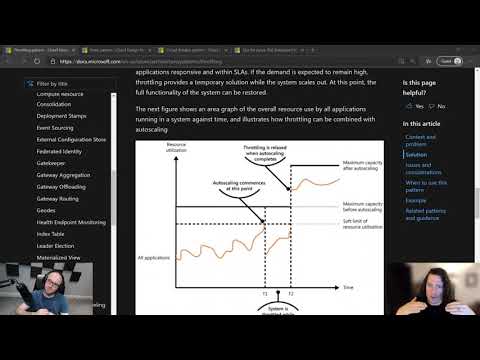
17 - The Throttling, Retry and Circuit Breaker Patterns
How do you protect your infrastructure from traffic spikes, safeguard multi-tenant workloads from noisy neighbours, and handle transient failures gracefully? Chris and John Downs walk through three essential cloud resilience patterns: Throttling (protecting services from excess load via rate limiting and HTTP 429), Retry (handling transient faults with exponential backoff), and Circuit Breaker (preventing cascade failures). Part of the "Architecting for the Cloud, One Pattern at a Time" series — essential viewing for any developer building on Azure.
15 - The Sharding and Index Table Patterns
Concerned about the scalability of your data layer, or do you need data segregation for customers with regional data residency requirements? The Sharding pattern addresses exactly these challenges. If you are using a NoSQL data store without native secondary index support, the Index Table pattern provides an elegant solution for efficient querying. In this episode, Chris is joined by Steph Martin to explore both patterns in depth: shard key strategies (lookup, range, hash), cross-shard query design, the Azure SQL Database elastic client library, and how the Index Table pattern solves query efficiency challenges in stores like Cassandra and Cosmos DB.
16 - The Backends for Frontends and Strangler Pattern with Peter Piper
Managing APIs across web, mobile, and multiple consumer types creates tight coupling that slows modernisation and makes versioning painful. In this episode, Chris Reddington is joined by Peter Piper to explore the Backend for Frontends (BFF) pattern — creating dedicated backends tailored to each consumer — alongside the Strangler Fig pattern for incrementally migrating legacy monoliths without disrupting existing clients. The Façade pattern also features as a key decoupling mechanism for smooth API migrations. Part of the "Architecting for the Cloud, One Pattern at a Time" series.