DevOps Trends
Ten years is a long time in technology. What started as a cultural movement to break down the wall between development and operations has evolved into a sprawling ecosystem of practices, tools, and philosophies. Daniela Fontani — CTO and early open source contributor since 2006 — explores the key trends defining modern DevOps and how to keep up without chasing every new buzzword.
The Dev/Ops Chasm — Still Unsolved
Even with a decade of investment, many organisations still struggle with siloed teams and disconnected toolchains. The tooling problem is relatively straightforward — write a tool that integrates across layers. But the cultural and organisational shifts required are significantly harder and remain the primary blocker for most enterprises.
Key Trends to Watch
- DevSecOps: Security is no longer a gate at the end of the pipeline. Shifting security left — embedding it throughout CI/CD — is now a baseline expectation, not an aspiration. Every stage of the pipeline should have automated security checks.
- GitOps: Using Git as the single source of truth for infrastructure and application state is rapidly becoming standard practice for cloud-native teams. Infrastructure changes become pull requests, with full audit history and automated reconciliation.
- NoOps and Platform Engineering: As platforms become more automated and self-service, the role of traditional Ops is shifting toward internal developer platforms that abstract away infrastructure complexity and let developers ship faster.
- Observability over Monitoring: The industry is moving from reactive monitoring dashboards to proactive observability — structured logging, distributed tracing, and metric correlation that let you ask questions you did not know you needed to ask.
- Automation Everywhere: From infrastructure provisioning via Infrastructure as Code to automated testing pipelines, automation is the foundation of modern, high-throughput delivery.
How to Keep Up
The challenge is not knowing which trends exist — it is knowing which ones deserve your investment. Daniela’s practical advice: anchor your learning to outcomes. If a trend directly improves quality, speed, or security in your pipeline, prioritise it. If it is a buzzword without a clear problem it solves for your team, move on. The goal is continuous improvement, not constant reinvention.
Related Content

Find vulns in your code before they find you
Security vulnerabilities don't wait to be discovered — and developers are often unknowingly shipping them through open source dependencies. In this episode, Chris is joined by DeveloperSteve Coochin, Developer Advocate at Snyk, to explore the real-world state of vulnerabilities in modern applications. Steve shares findings from his research into the PHP ecosystem and explains how developers can shift vulnerability detection left — catching CVEs in dependencies before they reach production, by integrating tools like Snyk directly into their CI/CD pipelines and GitHub workflows.
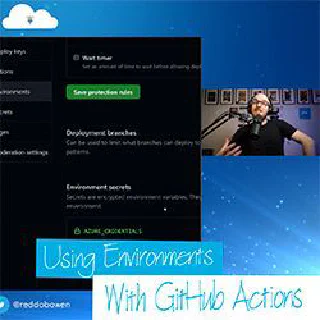
GitHub Actions and Azure - Using Environments with GitHub Actions
Once you have a working GitHub Actions workflow, the next challenge is safely deploying across dev, staging, and production with the right secrets in the right places. This episode deep-dives into GitHub Actions Environments: how to scope secrets per environment to enforce the principle of least privilege, configure required reviewers and wait timers as production gates, and assign service principals with minimal Azure RBAC permissions. A live demo deploys the cloudwithchris.com Hugo site to Azure Storage, making every concept concrete.

3 - DevOps in a Cloud World
DevOps is the union of people, process, and products to enable the continuous delivery of value to end users — not just code or features. In this episode, Abel Wang, Principal Developer Advocate and DevOps Lead at Microsoft, joins Chris to cover the foundations of DevOps, telemetry-driven development, database DevOps, feature flags, Site Reliability Engineering, and the importance of shifting left on quality and security.