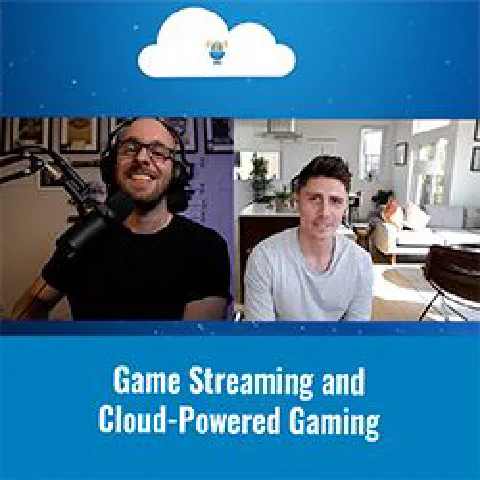
CGN7 - Cloud Gaming Notes Episode 7 - Game Streaming and Cloud-Powered Gaming
Chris Reddington and Lee Williams discuss game streaming — not live-streaming gameplay to an audience, but the technology that streams a game to your device from cloud-hosted infrastructure. This episode of Cloud Gaming Notes explores why cloud makes this possible and what it means for both players and game creators.
Key Topics Covered
- What game streaming actually is: The game runs on remote cloud infrastructure; only the video stream is sent to your device, with your inputs sent back in real time. Low latency is critical to a playable experience.
- Why cloud enables this: Economies of scale mean providers can amortise the cost of high-end GPU infrastructure across thousands of players, offering access via a subscription rather than requiring expensive local hardware.
- Consumer behaviour shift: Just as audiences moved from DVD libraries to Netflix and Spotify, gamers are increasingly comfortable with subscription-based access to game catalogues — Xbox Game Pass and Google Stadia as leading examples.
- Multi-device freedom: Players can switch between PC, phone, tablet, and TV without hardware lock-in — the game experience follows the user, not the device.
- Games as living services: For game creators, streaming shifts the model from a one-time retail release to a continuously updated, platform-style service with DLC, in-game economies, and ongoing subscriptions (Minecraft and GTA Online as prime examples).
- Development economics: Building for a streaming platform reduces per-platform porting costs and enables constant iteration, removing the need for major new release cycles to reach players on different devices.
Related Content
42 - How to choose the 'Right' Datastore for your scenario
With so many data store options in Azure — relational SQL, NoSQL, document databases, blob storage, key-value stores, and more — how do you choose the right one for your workload? In this episode, Chris Reddington is joined by Steph Martin to explore the concept of polyglot persistence and the trade-offs between data store types. From Azure SQL and Cosmos DB to blob storage and microservices data patterns, they discuss how workload requirements, access patterns, RTO/RPO targets, and application architecture should guide your data platform decisions. A practical guide for architects and developers navigating the modern data landscape on Azure.
CGN3 - Cloud Gaming Notes Episode 3 - Inventory and Economy
Gaming has evolved from isolated save files to persistent, cloud-powered experiences that follow players across every device they own. In this third episode of Cloud Gaming Notes, Chris and Lee Williams explore the cloud architecture behind in-game inventory and economy systems — using Sea of Thieves as a live example. Topics include persistent state management with Azure Cosmos DB, managed gaming backends with PlayFab, Live Ops patterns, and how cloud infrastructure enables monetisation and long-term player retention at scale.
CGN1 - Cloud Gaming Notes Episode 1 - Hosting a Game Server
Ever thought about what it takes to host a game in the Cloud? Well, this is the series for you! On the first Wednesday of every month, we explore Cloud Concepts that impact your journey to a connected multiplayer gaming experience! In this first session, we'll play some Minecraft and talk to the concept of a hosted game server.