
11 - The Geode Pattern - What is it and how can it be useful for my app?
You may have heard of patterns like the Retry pattern, Circuit Breaker, or CQRS — but have you heard of the Geode pattern?
In this Architecting for the Cloud, One Pattern at a Time episode, Chris and Will Eastbury — who contributed to the original Azure Architecture Center documentation for this pattern — explore how Geodes enable planet-scale, active-active applications.
Key concepts covered:
- What is the Geode pattern? Geodes are identical, globally distributed compute nodes where all nodes actively serve any request. Unlike Deployment Stamps (which constrain a tenant to a specific stamp), all Geodes contain the same data, enabling any node to serve any user
- Geodes vs Deployment Stamps: Deployment Stamps are tenant-scoped and support multi-tenancy models; Geodes prioritize global consistency and maximum compute utilization. The two patterns can be combined
- Performance and availability: The primary benefit is low latency for globally distributed users, with high availability as a natural side effect. Azure Front Door acts as the intelligent global load balancer routing requests to the nearest healthy Geode
- Data sovereignty considerations: Because data is replicated to all Geodes, organizations with strict regional data residency requirements need to plan carefully — potentially combining Geodes with Deployment Stamps for tenant-bounded slices
- Active-active vs active-passive: Geodes are designed for scenarios where active-passive is too expensive or wasteful; all nodes are live and independently scalable
- Hands-on demo: A globally distributed real-time voting application using Azure Functions (event bindings), Cosmos DB (change feed), and SignalR — demonstrating the event-sourcing and messaging aspects of the pattern in practice
- Intelligent edge evolution: How this pattern naturally extends to IoT edge and 5G scenarios, with millions of tiny Geodes in roadside cabinets all maintaining configuration from a central service
This episode was originally recorded on 9th October 2020, but had some technical issues and was re-recorded on 21st December 2020.
Related Content

18 - Tales from the Real World - Defying Gravity.. The magic behind Flight Simulator 2020
What's actually powering Microsoft Flight Simulator 2020 — and what can cloud architects learn from it? Chris Reddington takes to the virtual skies over Queensland with former colleague Cam Adams, flying a Cessna 172 from Archerfield aerodrome while discussing the real Azure services behind one of the most technically ambitious games ever made. From CDN-based asset distribution and event-driven live weather to PlayFab game backends and DDoS protection — this is cloud architecture on the fly.
17 - The Throttling, Retry and Circuit Breaker Patterns
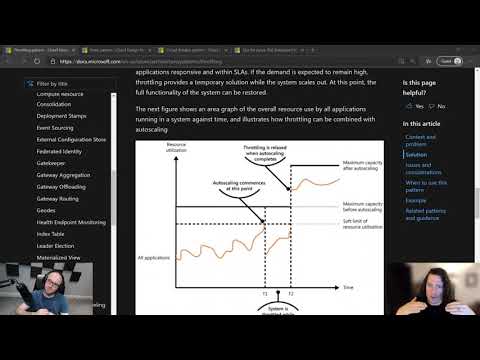
How do you protect your infrastructure from traffic spikes, safeguard multi-tenant workloads from noisy neighbours, and handle transient failures gracefully? Chris and John Downs walk through three essential cloud resilience patterns: Throttling (protecting services from excess load via rate limiting and HTTP 429), Retry (handling transient faults with exponential backoff), and Circuit Breaker (preventing cascade failures). Part of the "Architecting for the Cloud, One Pattern at a Time" series — essential viewing for any developer building on Azure.
15 - The Sharding and Index Table Patterns
Concerned about the scalability of your data layer, or do you need data segregation for customers with regional data residency requirements? The Sharding pattern addresses exactly these challenges. If you are using a NoSQL data store without native secondary index support, the Index Table pattern provides an elegant solution for efficient querying. In this episode, Chris is joined by Steph Martin to explore both patterns in depth: shard key strategies (lookup, range, hash), cross-shard query design, the Azure SQL Database elastic client library, and how the Index Table pattern solves query efficiency challenges in stores like Cassandra and Cosmos DB.