CGN1 - Cloud Gaming Notes Episode 1 - Hosting a Game Server
What does it actually take to host a multiplayer game server in the cloud? In this first Cloud Gaming Notes episode, Chris Reddington is joined by Microsoft Azure for Gaming specialist Lee Williams to explore how cloud infrastructure powers connected gaming experiences. Using a Minecraft server on Azure as a hands-on example, they cover virtual machine hosting, multiplayer scalability challenges, DDoS protection, player data privacy, resilience patterns, and the evolution from self-hosted servers to fully managed game-as-a-service platforms.
Chris and Lee walk through the practical steps of spinning up a Minecraft server on an Azure Virtual Machine, from VM SKU selection to network security group configuration. The conversation broadens into the architectural challenges facing any cloud-hosted game: handling player count spikes without over-provisioning, designing for resilience and uptime when players expect 24/7 availability, mitigating DDoS attacks that are endemic in the gaming space, and meeting GDPR data privacy requirements for player data. Lee shares how the Azure for Gaming team approaches these problems, and the episode closes with a look at the emerging game streaming model — xCloud and Stadia-style architectures — and what cloud-native design patterns make those possible.
Related Content
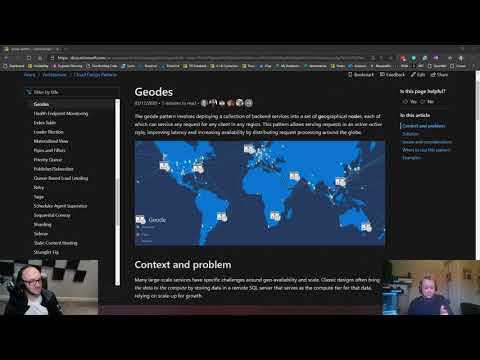
11 - The Geode Pattern - What is it and how can it be useful for my app?
You may know patterns like Retry, Circuit Breaker, or Deployment Stamps — but have you heard of the Geode pattern? In this Architecting for the Cloud episode, Chris and Will Eastbury (who contributed to the original Azure Architecture Center documentation for this pattern) explore how Geodes enable planet-scale, active-active applications where every node can serve any user from any region. Unlike Deployment Stamps (which are tenant-scoped), Geodes replicate data across all regions, eliminating active-passive compute wastage and delivering consistent low-latency experiences globally. The session covers key trade-offs around data sovereignty, replication costs, and the evolution toward intelligent edge deployments — and includes a walkthrough of a globally distributed real-time voting app built with Azure Functions, Cosmos DB, and SignalR.
18 - Tales from the Real World - Defying Gravity.. The magic behind Flight Simulator 2020
What's actually powering Microsoft Flight Simulator 2020 — and what can cloud architects learn from it? Chris Reddington takes to the virtual skies over Queensland with former colleague Cam Adams, flying a Cessna 172 from Archerfield aerodrome while discussing the real Azure services behind one of the most technically ambitious games ever made. From CDN-based asset distribution and event-driven live weather to PlayFab game backends and DDoS protection — this is cloud architecture on the fly.
24 - Health Endpoint Monitoring Pattern (Monitor your service and its dependencies!)
Stop waiting for users to tell you something is broken. The Health Endpoint Monitoring pattern gives your services a dedicated health-check endpoint that aggregates the status of all dependent components—databases, APIs, storage—into a single observable response. This episode covers the pattern in detail, including design considerations around caching, security, denial-of-service exposure, and integration with Azure Monitor and Application Insights.