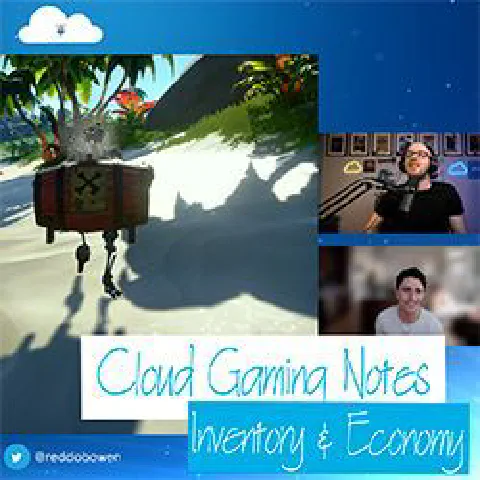
CGN3 - Cloud Gaming Notes Episode 3 - Inventory and Economy
In this third episode of the Cloud Gaming Notes series, Chris Reddington and Lee Williams load up Sea of Thieves to talk through the cloud engineering challenges behind one of gaming’s most critical systems: inventory and economy.
Key topics covered in this episode:
- Persistent player state — how modern games use cloud storage to ensure that every item, currency balance, and progression milestone is preserved across sessions and devices without the player needing to manage saves manually
- Inventory architecture — treating in-game objects as first-class cloud entities, and the relationship between in-game mechanics (swords, loot, ammo) and the backing data stores that represent them
- Economy design — structuring in-game currencies, rewards, and progression loops so they remain balanced, fair, and resistant to exploitation
- Azure Cosmos DB and PlayFab — choosing between building a custom inventory data layer on Cosmos DB versus adopting a fully managed gaming backend like PlayFab, and the trade-offs each approach involves
- Live Ops — continuously updating and evolving game content post-launch, and how cloud infrastructure supports rapid deployment of seasonal events, balance patches, and new rewards without server downtime
- Cross-platform and cross-device — designing inventory systems that follow a player from console to PC to mobile via cloud synchronisation
- Community and monetisation — how a well-designed economy builds long-term player engagement, supports streaming audiences, and opens monetisation opportunities for publishers
Next in the series: a conversation with Dominic from Australia on building a social Sudoku game with PlayFab.
Related Content
CGN1 - Cloud Gaming Notes Episode 1 - Hosting a Game Server
Ever thought about what it takes to host a game in the Cloud? Well, this is the series for you! On the first Wednesday of every month, we explore Cloud Concepts that impact your journey to a connected multiplayer gaming experience! In this first session, we'll play some Minecraft and talk to the concept of a hosted game server.
CGN2 - Cloud Gaming Notes Episode 2 - Matchmaking Services
Ever thought about what it takes to host a multiplayer game in the cloud? In the second episode of Cloud Gaming Notes, Chris and Lee Williams go hands-on with Halo 5 Guardians to explore the engineering behind matchmaking services. They cover the Actor model and Azure Service Fabric, skill-based matchmaking algorithms, the critical role of latency in competitive gaming, and how live ops and DevOps principles keep a game-as-a-service continuously updated without downtime. Real-world cloud architecture through the lens of AAA gaming.
28 - Intro to Landing Zones
What exactly is an Azure Landing Zone, and why does every cloud architect keep talking about it? In this episode, Chris Reddington is joined by Karim Fahmy — an Azure Solutions Architect with over 12 years of IT experience — to demystify Azure Landing Zones and their place within the Cloud Adoption Framework. Learn how landing zones provide the structured foundation covering networking topology, identity, governance, subscriptions, and security that your workloads need to succeed in the cloud. The episode also covers Azure Blueprints, Terraform automation, and real-world strategies for incrementally building and evolving your cloud foundation over time.